
129th INAUGURAL LECTURE: LASU DON URGE BANKS TO EXPAND CREDIT TO SMES, PRODUCTIVE SECTORS
Read Time:3 Minute, 40 Second
By Aishat Momoh. O.
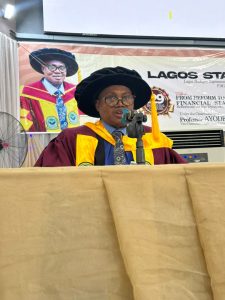
A Professor of Finance at Lagos State University, Sikiru Oyerinde Ashamu, has called for greater access to productive credit for small and medium-sized enterprises (SMEs) and other critical sectors of the Nigerian economy.
Ashamu made the call on Tuesday while delivering the 129th inaugural lecture of Lagos State University, where he examined the evolution of Nigeria’s banking sector, its reforms, crises and the need to build greater resilience.
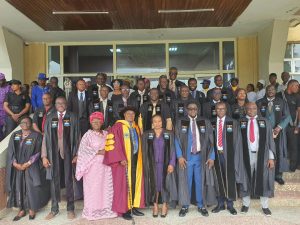
The professor argued that the growth and expansion of Nigeria’s financial sector must translate into broader economic development, noting that increased banking capacity had not completely addressed the challenge of access to affordable credit.
According to him, while large corporations continue to dominate formal credit allocation, many SMEs face challenges including high lending rates, stringent collateral requirements and limited access to finance.
He said banks needed to channel more credit towards productive sectors such as agriculture, manufacturing, infrastructure and SMEs rather than concentrating excessively on lower-risk investments.
Ashamu traced the vulnerabilities in Nigeria’s banking sector to issues including weak capitalisation, poor corporate governance, insider abuses, low depositor confidence and systemic distress.
He recalled that the banking reforms of 2004-2005 significantly transformed the industry, with the minimum capital requirement increasing from N2 billion to N25 billion and the number of banks reducing from 89 to 25 through mergers and acquisitions.
However, he noted that the reforms did not eliminate vulnerabilities in the sector, as the 2008 global financial crisis and Nigeria’s banking crisis of 2009-2010 exposed further weaknesses.
He said subsequent regulatory interventions and the establishment of the Asset Management Corporation of Nigeria (AMCON) were aimed at restoring confidence and strengthening financial stability.
Ashamu said the reforms had enabled larger banks to participate more effectively in international finance, finance large-scale projects and expand across African markets.
However, he stressed that increased size and capitalisation alone could not guarantee stability or ensure that the financial sector contributed sufficiently to national development.
The don identified stronger regulation, improved corporate governance, financial inclusion, cybersecurity and technological adaptability as key requirements for a resilient banking sector.
He called for stronger prudential and macroprudential supervision, including technology-driven regulatory systems capable of detecting systemic risks before they develop into crises.
On financial inclusion, Ashamu advocated investment in digital infrastructure, financial literacy, rural connectivity and inclusive banking technologies, particularly to improve access for underserved groups such as women, youths and low-income households.
He also urged financial institutions to strengthen cybersecurity and digital resilience as banking increasingly shifts towards digital platforms.
The professor further called for greater attention to sustainable and green finance, including financing for renewable energy, climate-smart agriculture and sustainable infrastructure.
He identified transparency, regulatory credibility, depositor protection and institutional integrity as critical to maintaining public confidence in the banking system.
According to him, the strength of a financial system should not be measured solely by the size of its institutions, but also by their ability to serve the population, support productive enterprises, withstand economic shocks and contribute to sustainable development.
The inaugural lecturer also highlighted his academic and administrative contributions to Lagos State University since joining the institution in 2004 after working with the Lagos State Ministry of Education, Alausa.
Ashamu said he transitioned from a Level 13 position in the ministry to an Assistant Lecturer at LASU, choosing Finance because of his conviction about its role in economic growth and development.
He subsequently served as Coordinator of Banking and Finance and held other administrative responsibilities across the university’s campuses, including serving as Acting Head of the Department of Banking and Finance.
During his tenure, he said postgraduate programmes were introduced and strengthened, including PG, M.Sc., MBF and Ph.D. programmes in Finance.
He also highlighted the collaboration between LASU and the Chartered Institute of Bankers of Nigeria, which enabled the M.Sc. in Finance programme to receive dual certification.
Ashamu further disclosed that he organised the department’s maiden international conference and served as Editor and Editor-in-Chief of the LASU Journal of Accounting, Finance and Insurance.
Reflecting on his career progression from Assistant Lecturer to Professor, he attributed his journey to perseverance, continuous professional development, mentorship, collaboration and commitment to academic excellence.
The lecture, which examined decades of banking reforms, financial crises and technological transformation, concluded with a call for sustained efforts to build a Nigerian financial system capable of supporting inclusive and sustainable economic development.


Happy
0 %

Sad
0 %

Excited
0 %

Sleepy
0 %

Angry
0 %

Surprise
0 %
 0
0
 0
0