
IS CHATGPT REALLY HELPFUL
Read Time:2 Minute, 52 Second
By OWOLABI OLUWADARA
In recent years, the rapid advancement of artificial intelligence has reshaped multiple sectors, with education being one of the most deeply affected. Among the AI tools making waves in classrooms around the world is ChatGPT, a conversational AI developed by OpenAI. Celebrated for its ability to generate human-like responses, summarize texts, explain complex concepts, and offer real-time assistance, ChatGPT is being widely adopted by both students and educators. However, while the tool brings undeniable benefits, it also presents significant challenges that the education sector must navigate carefully.
READ ALSO:
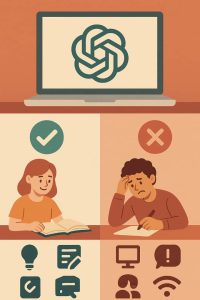
On the positive side, ChatGPT has emerged as a valuable support system for learners. Its accessibility makes it a powerful tool for students who may not have constant access to teachers, tutors, or high-quality educational resources. With just a few prompts, students can receive detailed explanations of difficult topics, generate writing ideas, and receive help with assignments. This has been particularly beneficial in under-resourced regions, where educational support is limited. Many students describe it as having a 24/7 tutor at their fingertips
.
Educators, too, have found practical uses for ChatGPT. Teachers are using the tool to design lesson plans, create quizzes, write teaching materials, and even brainstorm classroom activities. This allows them to focus more on interactive learning and student engagement. Furthermore, ChatGPT can be a helpful tool for students with learning disabilities or language barriers, as it can provide information in a simplified and customized manner, fostering inclusive learning environments.
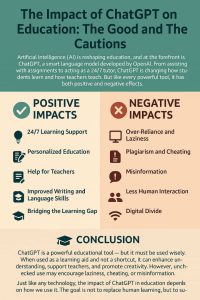
However, the increasing reliance on ChatGPT also raises serious concerns. One of the most pressing issues is academic dishonesty. With the AI capable of producing essays, solving math problems, and answering comprehension questions, many students are using it to complete their work with little to no effort. This undermines the learning process and devalues academic achievement. Educators report a noticeable rise in AI-assisted cheating, prompting institutions to adopt AI-detection tools and revise assessment strategies.
Moreover, there is a growing worry that overdependence on ChatGPT may hinder the development of essential cognitive skills. Students who rely heavily on AI for assignments may miss out on learning how to think critically, solve problems independently, and develop their own writing voice. These skills are vital not only for academic success but also for personal and professional growth.
There are also ethical implications to consider. AI tools like ChatGPT are trained on vast amounts of internet data, which may include biased or inaccurate information. Without proper guidance, students may accept AI-generated responses at face value, potentially reinforcing misinformation or biased viewpoints. This highlights the need for digital and AI literacy to be taught alongside traditional subjects.
Ultimately, the impact of ChatGPT on education depends on how it is used. When integrated thoughtfully and ethically, it has the potential to enhance learning, personalize education, and support both teachers and students. However, without proper safeguards and education on responsible usage, it could contribute to academic shortcuts and intellectual stagnation
.
As artificial intelligence continues to evolve, educators, policymakers, and students must work together to strike a balance. Rather than banning tools like ChatGPT, the focus should be on teaching students how to use them responsibly as a supplement to learning, not a replacement for it. The challenge ahead lies in shaping an educational culture that values integrity, curiosity, and critical thinking in the age of AI.


Happy
0 %

Sad
0 %

Excited
0 %

Sleepy
0 %

Angry
0 %

Surprise
0 %
 0
0
 0
0