
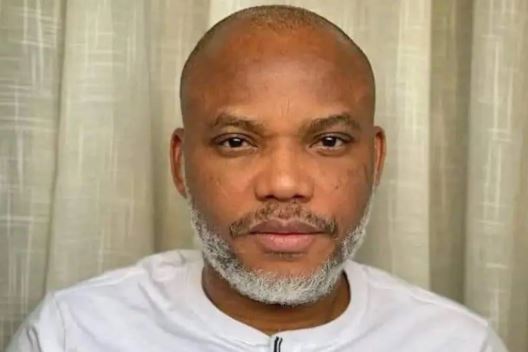
SOUTHEAST MONARCH URGES TINUBU TO FREE NNAMDI KANU OR SEND HIM BACK TO KENYA
Read Time:3 Minute, 55 Second
By: Balogun Ibrahim
A South-East traditional ruler on Tuesday called on President Bola Ahmed Tinubu to either release Nnamdi Kanu, the convicted leader of the Indigenous People of Biafra, or return him to Kenya, where he was initially arrested, warning that his continued detention was heightening unrest among youths in the region.
The appeal was made by Dr. Lawrence Agubuzu, the Eze Ogbunechendo of Ezema Olo Kingdom, during the 2026 National Traditional and Religious Leaders Summit on Health at the State House Conference Centre in Abuja.
“Bring this man out. If we don’t want him in Nigeria, return him to Kenya or London where they took him from. Please do something about this. We cannot make progress in this country if we don’t tell ourselves the truth,” Agubuzu told the President.
The summit, themed “The Role of Traditional and Religious Leaders in Advancing the Nigeria Health Sector Renewal Investment Initiative,” was organised to strengthen community involvement in health sector reforms. The event also included the signing of a compact by traditional and religious leaders, pledging to promote and support healthcare delivery in their communities.
READ MORE…
TINUBU PAYS TRIBUTE: JESSE JACKSON DEFENDS NIGERIA’S DEMOCRACY
However, proceedings took an unexpected turn during goodwill messages when Dr. Agubuzu raised the issue of Nnamdi Kanu’s fate with President Bola Ahmed Tinubu.
“I must tell you, Mr. President, that personally I don’t feel very happy because you were not here in the morning when the Ooni of Ife gave the opening remarks and encouraged us to work as one,” he said.
The Enugu-based monarch questioned the sincerity of the unity message, claiming that the same royal father was planning to confer a high traditional honour on Yoruba Nation activist Sunday Igboho, whom he described as Nnamdi Kanu’s counterpart in the South-West.
“The ball is in your court. Bring this man out. If we don’t want him in Nigeria, return him to Kenya or London where they took him from,” he said.
Dr. Agubuzu also warned of growing unrest among South-East youths, noting that traditional rulers were losing credibility over the unresolved Kanu issue.
“Some of us here are being asked to go and work, but the young people in the South-East are so agitated they can even beat us,” he added.
“They see us as sell-outs. When we come to Abuja, they may think we’re here to collect money and then stay silent,” he said.
Nnamdi Kanu, 58, a British-Nigerian activist and founder of the banned Indigenous People of Biafra (IPOB), has been at the centre of one of Nigeria’s longest-running and most politically sensitive legal disputes.
Kanu’s Legal History
Nnamdi Kanu was first arrested in Lagos in October 2015 on charges of treasonable felony over his separatist broadcasts on Radio Biafra. He was arraigned at the Federal High Court and detained for over a year before Justice Binta Nyako granted him bail in April 2017 on health grounds.
After a military raid on his Afaraukwu, Umuahia residence during Operation Python Dance II in September 2017, Kanu fled the country. His bail was revoked, and the Federal Government proscribed IPOB as a terrorist organisation.
In June 2021, the Federal Government announced Kanu’s re-arrest and return to Nigeria from Kenya, a move his legal team described as an extraordinary rendition.
In October 2022, the Court of Appeal ordered his release, ruling that the rendition invalidated the charges. However, the Supreme Court of Nigeria overturned this decision in December 2023, directing that he stand trial at the Federal High Court.
On November 20, 2025, Justice James Omotosho found Kanu guilty on seven terrorism-related counts and sentenced him to life imprisonment, along with concurrent terms on other charges. He was later transferred to the Sokoto Correctional Centre.
Summit Highlights
Meanwhile, the Coordinating Minister of Health and Social Welfare, Prof. Muhammad Ali Pate, described the summit as the first comprehensive engagement with traditional and religious leaders since health sector reforms began over two years ago.
Goodwill messages were delivered by representatives from the World Health Organization, the World Bank, and the Chairman of the Senate Committee on Health.
The First Lady, Senator Oluremi Tinubu, delivered the keynote address, calling on traditional and religious leaders to back the National Community Food Bank Programme, set for nationwide rollout in April.
The summit also marked the launch of the second cohort of the National Health Fellows programme and included the signing of a compact designed to enhance community engagement, transparency, and accountability in healthcare delivery.
President Bola Ahmed Tinubu later gave remarks during the afternoon session of the summit.


Happy
0 %

Sad
0 %

Excited
0 %

Sleepy
0 %

Angry
0 %

Surprise
0 %
 0
0
 0
0