
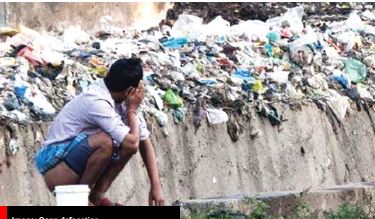
LAGOS RESIDENTS EXPRESS CONCERN OVER OPEN DEFECATION ON KUDIRAT ABIOLA WAY
Read Time:5 Minute, 58 Second

By: Muftau Fatimo
Residents of Oregun in the Ojota area of Lagos State have expressed concern over the growing incidence of open defecation in parts of the community.
They warned that if the situation is not addressed, the practice could gradually turn the once serene environment into an area polluted by human waste.
Residents and traders operating around the open drainage in front of Clay Bus Stop, before Juli Estate on Kudirat Abiola Way in Oregun, inward Ojota, complained that the foul odor emanating from the drainage—caused by the practice—has made commuting and conducting business in the area increasingly difficult.
The Lagos State Government has repeatedly warned residents and visitors to refrain from open defecation across the state.
In a recent advisory message posted on its Facebook page, the state government warned against the practice and urged residents to take responsibility for their environment, keeping the state clean and safe.
When the nedia visited the area on March 10, 2026, the smell of urine and faeces was choking.
The smell creates an uncomfortable atmosphere for people passing through the bus stop to their destination.
READ MORE :
EPL: CHELSEA COACH ROSENIOR CRITICIZES REFEREE OVER INTRUSION DURING PRE-MATCH HUDDLE
Our correspondent noticed faeces, some lay scattered in the drainage, while others were packed in nylon.
Speaking with the media, the residents lamented that some unknown individuals have resorted to defecating in the drainage channel.
A resident, Mrs Taiwo Ayodeji, lamented the practice and called for the government’s intervention.
“Over the years, I have noticed that the open drainage is being used by some people as their toilet, and they litter the drain with faeces.
“I wish the government could do something about this so residents of the area can walk the way without irritation. I get so irritated each time I pass through there. This is the middle of a town, and it is very bad,” she said.
Also, a food vendor in the area, who simply identified herself as Nneka, alleged that people defecate in the drainage overnight.
“This issue has become very disturbing. When we come early in the morning, we’ll just see that people have defecated in the drainage. The smell alone is enough to make people uncomfortable, especially those of us who run businesses around here,” she said.
Another resident, Razaq Sanni, said that the practice could impact public health if not checked.
Sanni said, “What is happening here is not good for public health at all. When it rains, the waste is washed across other drainage and spreads around the area. We are worried because we have children who play around, and if nothing is done, it can easily lead to disease outbreaks.”
Also speaking, Ifeanyi Succes, explained that the smell of faeces in the area had become a familiar thing.
Succes, who works in one of the factories around the area, said he uses the bus stop to connect to a bus or a tricycle going to Ojota, adding that faeces usually dots the drainage.
“It’s normal here, I have seen that several times. Both fresh and dry poos are always in the drainage. I actually don’t know why people do such in this area. The government and community leaders need to intervene before the situation gets worse,” he said.
As a measure to curb the menace, a Lagos Magistrate Court recently convicted and fined 17 residents for engaging in open defecation and urination.
The Lagos State Government disclosed this on its official verified X handle.
According to the Lagos State Government, the offenders were apprehended by the Lagos Waste Management Authority.
They were arraigned before a Magistrate Court in Bolade, Oshodi, where each was fined ₦40,000 or given the alternative of one month’s imprisonment.
Data from the Ministries of Environment and Water Resources and Sanitation indicate that about 48 million Nigerians still practise open defecation, with many relying on bushes and water bodies for waste disposal.
Given the scale of the problem and the nationwide shortage of sanitation facilities, some public health experts have expressed doubts about Nigeria’s ability to attain open defecation-free status by 2030.
However, UNICEF estimates that Nigeria would need roughly 20 million additional toilets to eliminate open defecation by 2030, in line with the targets of the United Nations Sustainable Development Goals.
Public health experts warned that open defecation poses serious health risks not only to those engaging in it but to the general population and can expose millions to preventable diseases.
According to them, faecal matter and urine deposited in open areas contaminate water sources and pollute the air.
A public health physician and infectious disease expert, Prof. Adebayo Onajole, said infectious and harmful pathogens spread through open defecation.
“When defecation is open and not treated, everybody around there, both immediate and distant, is exposed to the threat of infection.
“Defecation often contains a lot of pathogens. Some of them are harmful and infectious. When people defecate in an open space, it can easily spread to others through contamination of surface or underground water,” the don told the media.
Also, an epidemiologist, Dr Japhet Olugbogi, explained that several diseases can be spread through open defecation.
“Diseases like roundworms and parasites can be contracted through open defecation. When it rains, floodwater drives the matter into homes or into places where children may touch or put things into their mouths.
“Apart from that, diseases such as polio, typhoid, rotavirus and several others have been linked to open defecation. These are illnesses transmitted through what people ingest—from hand to mouth—and the practice significantly contributes to their spread.
“Beyond the offensive odour in areas where open defecation is common, people who eat in such environments are also at risk. Flies can land on human waste, pick up contaminants and later settle on food, thereby exposing people to infection,” he said.
Government response
Meanwhile, the Lagos State Government has said the Oregun area will be added to locations under heightened surveillance as part of efforts to curb open defecation across the state.
Speaking in an interview with our correspondent, the spokesperson for the Lagos State Ministry of Environment and Water Resources, Kunle Adesina, said the ministry would take immediate steps to address the situation.
“I will notify the relevant department responsible for this, as we also have an environmental sanitation task force. Now that the issue has been brought to our attention, I will alert them so they can intensify monitoring in that area,” he said.
He added that anyone found violating sanitation regulations would face legal consequences in accordance with the law.
“For example, in locations such as expressway corridors and border areas, we have established task forces made up of security and paramilitary personnel, Kick Against Indiscipline officers, and representatives from transport unions. They operate around the clock to monitor these zones.
“When individuals are apprehended, they are brought before mobile courts. The same approach will be applied to anyone caught engaging in such acts in the Oregun area. We will ensure strict enforcement, and anyone found violating the law will face the appropriate consequences,” he assured.


Happy
0 %

Sad
0 %

Excited
0 %

Sleepy
0 %

Angry
0 %

Surprise
0 %
 0
0
 0
0