
EXCLUSIVE: ALLEGED COUP PLOT TARGETED ASO ROCK AND PRESIDENT TINUBU, OFFICIALS CLAIM
Read Time:5 Minute, 10 Second
By: Balogun Ibrahim
Investigators have revealed details of a troubling coup plot that, if carried out, could have thrown Nigeria into severe political and security chaos.
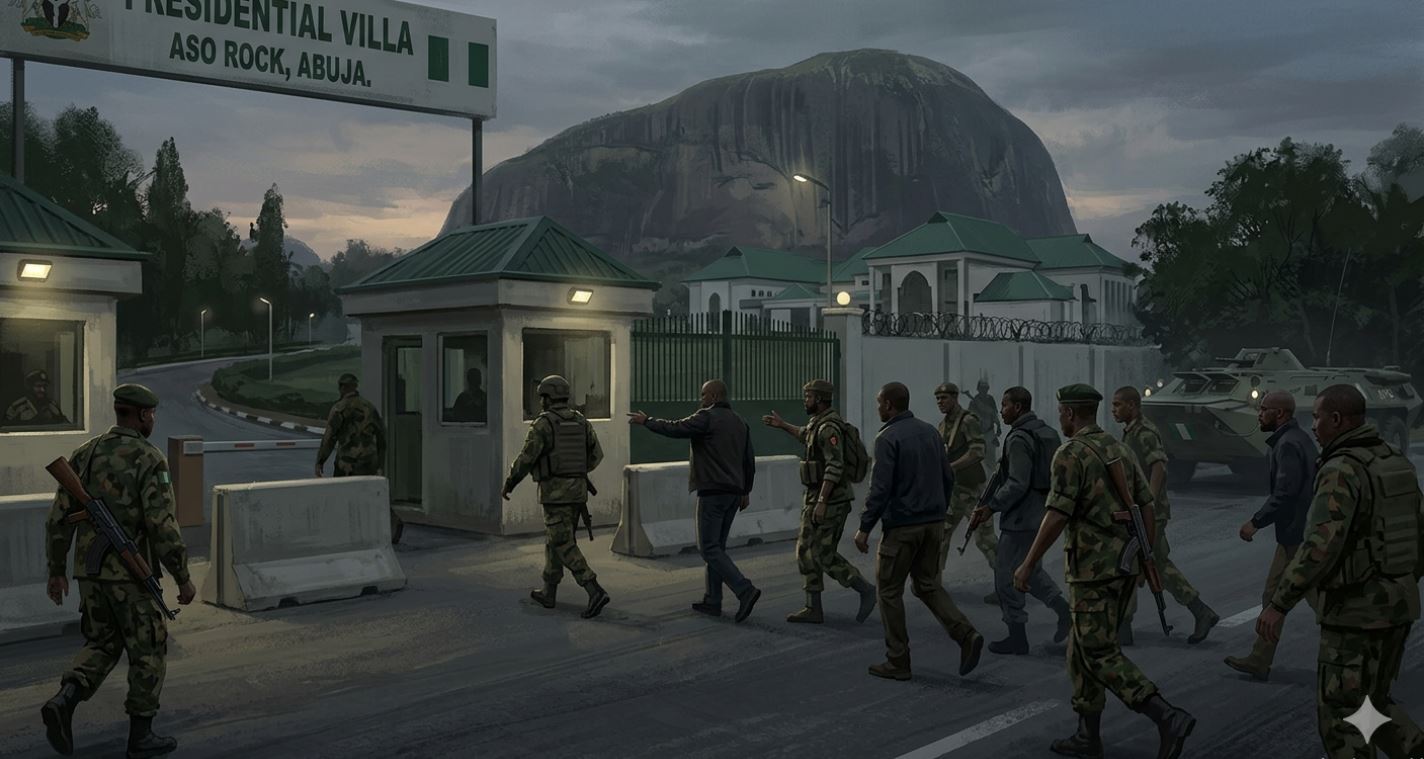
The Media has obtained new information indicating a sophisticated plan by suspected coup plotters to attack Nigeria’s seat of power, seize the Presidential Villa, and detain President Bola Tinubu along with other senior officials in a coordinated operation involving key military and national installations.
Reports reveal that, in addition to earlier accounts of assassination attempts, the alleged conspirators had mapped out a multi-layered strategy to take control of Aso Rock and other critical sites, neutralise top military leadership, and disrupt Nigeria’s command and governance structures.
Central to the alleged conspiracy was a plot to storm the Presidential Villa in Abuja, Nigeria’s most secure political complex, and apprehend President Bola Tinubu along with Vice President Kashim Shettima.
The plan reportedly also targeted Senate President Godswill Akpabio and House Speaker Tajudeen Abbas, who were to be captured and potentially eliminated.
Investigators revealed that certain officers were assigned to spearhead the assault on the Presidential Villa, forming what sources described as the operation’s “decapitation unit.”
The alleged plot reportedly targeted not only political leaders but also top security officials, including National Security Adviser Nuhu Ribadu, then Inspector-General of Police Kayode Egbetokun, and State Security Service Director-General Adeola Ajayi, all identified as high-value targets.
According to multiple reliable sources, the operation was reportedly designed as a full-scale military takeover, with units assigned to seize strategic locations simultaneously.
While one team was tasked with attacking the Presidential Villa, another was reportedly assigned to take control of the Niger Barracks, a key military installation overlooking the Villa and home to Nigeria’s top military chiefs.
Specific officers at the barracks were allegedly designated to eliminate senior officers, including the Chief of Defence Staff and service chiefs.
Additional units were said to be deployed to capture the Armed Forces of Nigeria Complex in the Garki District of Abuja and secure Nnamdi Azikiwe International Airport, effectively severing both military coordination and escape routes.
A senior security source described the plan as “highly coordinated, with clear command structures, targets, and timelines,” indicating that it went well beyond a loosely organised plot.
Investigators noted that the alleged network involved operational, logistical, and psychological elements, covering everything from battlefield coordination to messaging strategies.
Officers A.A. Hayatu, D. Yusuf, M.A. Usman, Binuga, and A.A. Yusuf were reportedly assigned to strike the Presidential Villa.
Lieutenant Colonel S. Bappah was reportedly assigned to eliminate the Chief of Defence Staff, while Lieutenant Colonel P. Dangnap was tasked with targeting the Chief of Army Staff.
Officer A.A. Dauda was assigned to strike the Chief of Air Staff, and Major Jiddah was tasked with eliminating the Commander of the Guards Brigade.
Sources say this phase of the alleged plot was designed to paralyse military response and prevent organised resistance to the takeover.
Beyond Aso Rock and the Niger Barracks, the conspiracy reportedly extended to other strategic installations in Abuja.
Officer D.B. Abdullahi was designated to lead the team targeting the Armed Forces of Nigeria Complex, while Officer S.B. Adamu was assigned to head operations to seize Nnamdi Azikiwe International Airport, securing key entry and exit routes into the capital.
Investigators said that the coordinated capture of these sites would have effectively given the plotters operational control of Abuja within hours.
The alleged conspiracy involved at least 40 suspects, including senior officers such as Brigadier General M.A. Sadiq and Colonel M.A. Ma’aji, along with several lieutenant colonels drawn from signals, infantry, and special forces units.
Other officers reportedly named in the investigation include Lieutenant Colonels A.A. Hayatu, P. Dangnap, M. Almakura, and S.M. Gana, along with majors and captains embedded across various units.
Investigators say the network also involved civilians in supporting roles, including Umoru Zekeri, an electrician at the Presidential Villa; Ali Isah, an ambulance driver; and Nollywood actor Stanley Kingsley Amandi, allegedly recruited to coordinate propaganda efforts during the operation.
Weapons and logistics
Security agencies reportedly recovered a large cache of weapons and operational assets linked to the suspects, including gun trucks, anti-aircraft weapons, RPGs, machine guns, and substantial quantities of ammunition.
Dozens of vehicles were also seized, including Toyota Hilux trucks and Volkswagen Golf cars, believed to have been intended for rapid deployment and covert movement within Abuja.
ABIA REPORTS ARREST OF INJURED SOLDIER FOLLOWING VISIT TO OTTI
Sources familiar with the investigation said the scale of the seizures demonstrated “serious intent and preparedness,” highlighting how close the plot may have been to execution.
The suspects were arrested in a covert joint operation involving Army Headquarters and the State Security Service. While many remain in detention, civilians linked to financing and logistics are being investigated by the Economic and Financial Crimes Commission (EFCC) and the SSS.
The Defence Headquarters has confirmed that its investigations into the alleged coup plot are complete and that the findings have been submitted to senior authorities for further action, describing the conduct as a serious violation of military ethics and professional standards.
Two high-profile individuals—a retired major general and former Bayelsa State Governor Timipre Sylva—have been linked to the network and remain at large.
Families of suspects push back
The families of the detained suspects, however, have challenged the official narrative, claiming their relatives have been held for over 160 days without a fair hearing.
At a recent press briefing, the families called for an open trial and access to the detainees, citing inconsistencies in the authorities’ account and warning against “trial by media.”
They also raised concerns over changing claims about funds allegedly connected to the suspects, urging the government to respect constitutional guarantees of due process.
“We are not asking for favours,” the families said. “We are asking for justice, transparency, and the truth.”
With authorities confirming that investigations have concluded, focus is now shifting to the next stage: prosecution.
Questions remain, however, over whether the suspects will face a public trial as demanded by their families or be subjected to closed military proceedings.


Happy
0 %

Sad
0 %

Excited
0 %

Sleepy
0 %

Angry
0 %

Surprise
0 %
 0
0
 0
0