
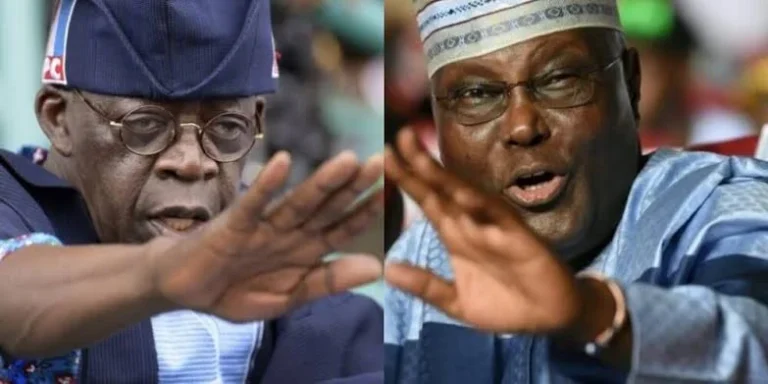
2027 POLITICS: ATIKU-TINUBU CLASH DEEPENS OVER SUBSIDY, $16BN POWER PROJECTS
Read Time:3 Minute, 40 Second
By:Tajudeen Aminat
Former Vice President Atiku Abubakar has challenged the Federal Government to investigate and prosecute him if it has evidence linking him to the alleged $16bn power sector expenditure during his time in office.
Atiku, the African Democratic Congress presidential candidate, accused the administration of President Bola Tinubu of reviving old allegations to divert attention from questions surrounding the use of funds saved from the removal of petrol subsidy.
In a statement issued on Wednesday by his Senior Special Assistant on Public Communication, Phrank Shaibu, Atiku said the renewed controversy over power projects, privatisation and public assets was an attempt to shift attention away from the economic difficulties confronting Nigerians.
The controversy over the power sector expenditure and commitments under the administration of former President Olusegun Obasanjo, commonly estimated at about $16bn, resurfaced following a House of Representatives investigation after the administration left office in 2007.
Atiku said the allegations had been repeatedly raised over the years without leading to his prosecution, despite successive administrations having access to the country’s investigative agencies.
He maintained that he was never invited by the National Assembly to respond to allegations of wrongdoing concerning the power projects.
According to him, although he chaired the National Council on Privatisation as Vice President, he disagreed with the concept of the power project and did not oversee its implementation, which he said was handled by the relevant minister.
Atiku urged the government to investigate him and present any evidence before a court if it believed he had committed an offence.
He said the allegations should not be used as a distraction from his demand for accountability over the funds generated since the removal of fuel subsidy.
Atiku also questioned how the government had deployed the savings from subsidy removal, asking, “Where is the people’s money?”
He argued that Nigerians had endured higher petrol, transportation and food prices based on the promise that subsidy savings would be redirected towards development.
The former Vice President further criticised the government’s fiscal policies, alleging that powerful interests continued to benefit from incentives, waivers, tax credits and concessions while ordinary Nigerians bore the brunt of economic reforms.
He maintained that the government could not remove relief from poor Nigerians, celebrate increased revenues and then claim that interventions benefiting citizens were economically irresponsible.
The controversy comes amid growing political tension ahead of the 2027 presidential election, with Atiku making economic hardship, accountability and the management of public funds central to his criticism of the Tinubu administration.
The Presidency, however, criticised Atiku over his position on fuel subsidy, accusing him of making contradictory statements about his proposed policy.
The Special Adviser to the President on Information and Strategy, Bayo Onanuga, said Atiku and his aides had offered different explanations about whether a government under him would restore, retain or eventually phase out fuel subsidy.
Onanuga urged Atiku to clearly explain his proposed targeted subsidy, including its cost, beneficiaries, funding source and the conditions that would determine its eventual removal.
The presidential aide also argued that petrol prices were not the only factor driving the cost of living, pointing to insecurity, exchange rates, logistics, storage, flooding and agricultural input costs as other contributors to inflation.
He questioned Atiku’s proposal to link subsidy to crude oil prices, noting that crude oil refining produces several other products, including diesel, aviation fuel and kerosene.
The Presidency maintained that Nigeria needed a comprehensive economic policy rather than what it described as policy inconsistencies and election-driven promises.
Meanwhile, the All Progressives Congress challenged Atiku to approach the courts if he had evidence to support his allegation that “thieves” were responsible for the country’s political and economic problems.
The APC Director of Publicity, Bala Ibrahim, said Atiku should present his allegations before the judiciary and allow the court to determine their validity.
The National Association of Nigerian Students also criticised Atiku’s proposal to restore fuel subsidy if elected president in 2027.
NANS President, Akinteye Babatunde, described the proposal as a political response to economic hardship rather than a sustainable solution to Nigeria’s fiscal challenges.
He argued that the previous subsidy regime consumed trillions of naira, encouraged smuggling and limited the government’s ability to invest in critical sectors.
Babatunde, however, stressed that the success of subsidy removal should ultimately be measured by how effectively the savings are deployed to improve the lives of Nigerians.


Happy
0 %

Sad
0 %

Excited
0 %

Sleepy
0 %

Angry
0 %

Surprise
0 %
 0
0
 0
0