
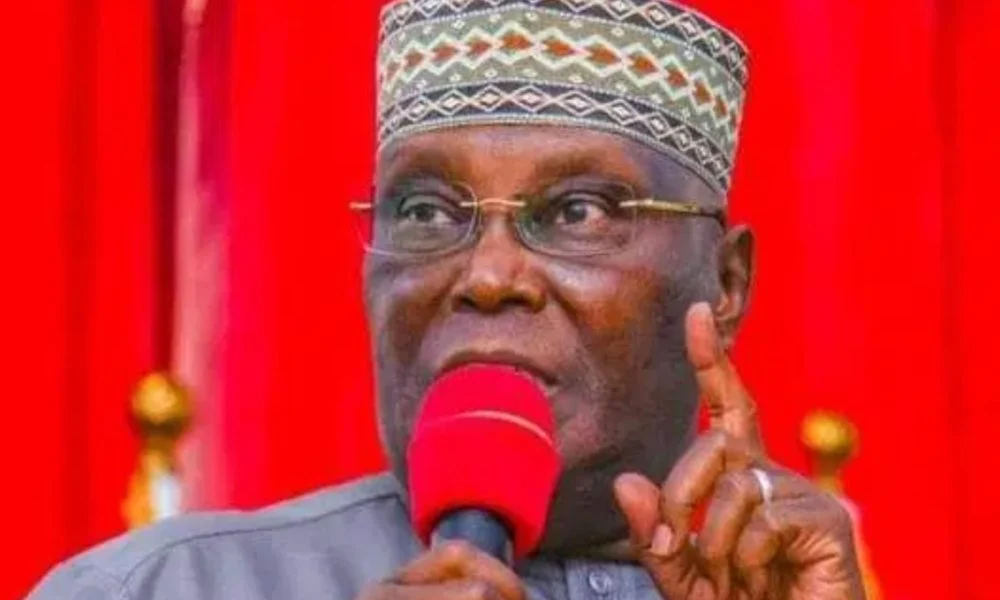
ATIKU: TINUBU’S ECONOMIC POLICIES ARE MAKING NIGERIANS POORER
Read Time:2 Minute, 44 Second

By: Fasasi Hammad
The African Democratic Congress (ADC) presidential candidate, Atiku Abubakar, on Tuesday accused President Bola Tinubu’s administration of pursuing economic policies that export Nigeria’s wealth in raw form while leaving citizens to grapple with rising prices, declining purchasing power and struggling industries.
Atiku made the allegation in a statement issued by his Senior Special Assistant on Public Communication, Phrank Shaibu.
The former Vice President said the contradiction in the nation’s economy had become increasingly difficult to conceal, noting that while Nigeria’s exports of raw materials were rising, manufacturers were reportedly sitting on trillions of naira worth of unsold goods due to weak consumer demand.
Atiku described the situation as a “painful paradox” in which Nigeria’s ports were recording increased exports while Nigerians were struggling to afford basic goods and businesses were battling unsold products.
“This is the painful paradox of Tinubu’s economy: the ships are leaving our ports full, but the pockets of Nigerians are empty. Government celebrates exports and trade surpluses while families are cutting meals, businesses are counting unsold stock and manufacturers are struggling to keep their gates open,” he said.
Reports indicated that Nigeria’s raw-material exports increased by 106 per cent, rising from N1.86 trillion in the first half of 2025 to N3.84 trillion in the corresponding period of 2026.
According to Atiku, the issue was not with exporting commodities but with Nigeria exporting them without sufficient processing and subsequently importing finished products at significantly higher costs.
“There is nothing wrong with exporting. The problem is exporting the cheapest part of the value chain and buying back the expensive part,” he said.
He cited cocoa beans, hides, cotton and minerals as examples, arguing that Nigeria should process its raw materials into higher-value products such as cocoa butter, cocoa powder, chocolate, leather goods and garments before exporting them.
“When we export cocoa beans instead of cocoa butter, powder and chocolate, hides instead of leather products, cotton instead of garments and minerals without processing them, we are handing other countries the opportunity to make the real money from resources that came from Nigerian soil,” Atiku said.
He added, “That is not how prosperous nations are built. Nigeria must stop behaving like a loading bay for raw materials.”
The ADC candidate further identified declining purchasing power among Nigerians as evidence, in his view, of the shortcomings of the Tinubu administration’s economic policies.
He said unsold manufactured goods had risen to about N2.14 trillion, attributing the development to weak demand, high production costs and consumers’ inability to keep pace with rising prices.
Atiku said the value of unsold goods was more than a manufacturing statistic, describing it as a reflection of the financial pressure faced by Nigerian households.
“That N2.14 trillion sitting in warehouses is not just a manufacturing statistic. It is a picture of the Nigerian family,” he said.
He explained that the situation represented families unable to afford goods they needed, salary earners whose incomes were consumed by transport, electricity and food costs, as well as traders whose customers could no longer afford their products.
“Nigerians have not stopped needing these products. Tinubu’s economy has simply made them too poor to buy enough of them,” Atiku added.


Happy
0 %

Sad
0 %

Excited
0 %

Sleepy
0 %

Angry
0 %

Surprise
0 %
 0
0
 0
0