
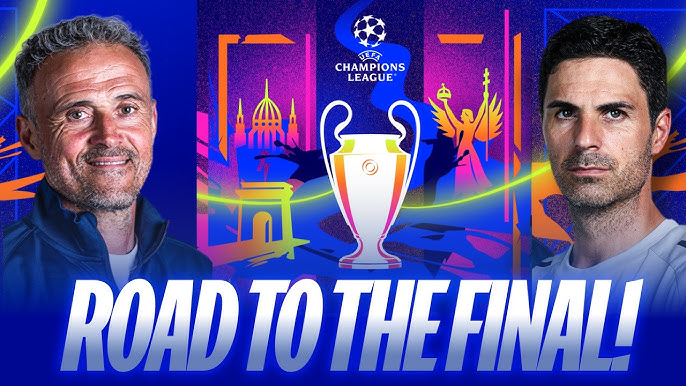
CHAMPIONS LEAGUE FINAL: PSG EXPERIENCE MEETS ARSENAL’S DREAM
Read Time:4 Minute, 34 Second

By: Fasasi Hammad
As the curtain falls on the 2025/26 European club football season tonight in Budapest, two champions collide on the grandest stage. Premier League winners Arsenal face Ligue 1 champions Paris Saint-Germain in a UEFA Champions League final that promises drama, intensity and fine margins.
Finals are often decided by moments rather than form. A flash of brilliance, a defensive mistake or a controversial refereeing call can alter the course of history. Once the whistle blows, everything that came before becomes secondary.
Much of the pre-match conversation has centred on Ballon d’Or holder Ousmane Dembélé. Long regarded as one of football’s most gifted talents, the French winger has flourished under PSG manager Luis Enrique, who has helped him blend creativity with discipline to become one of Europe’s most influential attackers.
Dembélé’s 2025/26 campaign has been carefully managed. Injuries and squad rotation limited his domestic involvement, with the forward making just 22 league appearances, 11 of them starts, while scoring 10 goals. However, the reduced workload was less about declining influence and more about preserving his fitness for PSG’s primary objective — European glory.
That strategy has yielded results. Dembélé has delivered when it mattered most in the Champions League, recording seven goals and two assists in 12 appearances. His decisive strike against Bayern Munich in the quarter-finals helped PSG progress 6-5 on aggregate and underlined his importance on Europe’s biggest stage.
READ MORE…
VIDEO: ‘KEEP BELIEVING’ — HAMILTON SENDS EMOTIONAL MESSAGE TO ARSENAL
Luis Enrique’s tactical approach has also transformed PSG into a more complete side. Rather than relying solely on individual brilliance, the French champions have developed into a cohesive unit. Dembélé retains freedom in attack but also shoulders significant defensive responsibilities, leading the press and contributing to the team’s collective intensity.
PSG’s domestic dominance over recent seasons has enabled the club to prioritise European success. With the league title secured early, Enrique rotated his squad extensively, ensuring players remained fresh for the latter stages of the Champions League. It was a lesson learned from previous campaigns when the Parisians peaked too early and faded in Europe.
The result is a PSG side that appears more balanced than ever. By the semi-finals, they looked among the competition’s most complete teams, capable of pressing aggressively, defending compactly and attacking with devastating speed. Dembélé has been central to that evolution.
Arsenal, meanwhile, arrive in Budapest carrying their own compelling narrative. Under Mikel Arteta, the Gunners have enjoyed a remarkable season, ending a 22-year wait for a Premier League title and reaching the Champions League final unbeaten in Europe.
Yet history remains a lingering subplot. Arsenal have never lifted Europe’s premier club trophy. Memories of their 2006 final defeat and subsequent near misses continue to hover around the club. While players often dismiss such narratives, the psychological burden of history can become significant in high-pressure moments.
For key figures such as Declan Rice, Bukayo Saka and Martin Ødegaard, this is unfamiliar territory. Winning a domestic title is one challenge; conquering Europe is another entirely. PSG, despite their own disappointments, have recent experience of Champions League finals and know the demands of such occasions.
Luis Enrique understands the mental side of elite competition better than most. Having won the Champions League with Barcelona and PSG, he knows that finals are not determined by reputation but by execution in crucial moments.
Arsenal’s greatest strengths are their unity, tactical discipline and belief. This group has developed together under Arteta’s guidance and has shown throughout the season that it can compete with Europe’s best. Their organised pressing and ability to control matches have dismantled elite opposition before.
However, belief can be tested under the immense pressure of a final. PSG’s players possess the experience of previous European campaigns, and that hard-earned knowledge could prove invaluable when tension rises.
The tactical contest is likely to be decided in midfield and on the flanks. PSG’s dynamic Portuguese duo, Vitinha and João Neves, have become the heartbeat of Enrique’s system, dictating tempo and driving transitions. Declan Rice’s ability to disrupt their rhythm may prove crucial to Arsenal’s hopes.
Arteta has built a team capable of adapting to different scenarios. Arsenal can dominate possession, strike effectively from set-pieces and remain organised without the ball. Their blend of technical quality and physical presence makes them a formidable opponent.
If there is an Arsenal side capable of ending the club’s long wait for European glory, it may well be this one. Young, fearless and tactically mature, the Gunners possess the qualities required to make history.
Yet they face a PSG team meticulously prepared for this moment. A side that sacrificed domestic minutes to preserve energy for Europe. A side led by a manager with a proven Champions League pedigree. And a side still capable of turning to Dembélé for a decisive contribution when it matters most.
Tonight in Budapest, Arsenal’s ambition collides with PSG’s experience. One club will celebrate a historic triumph, while the other will be left wondering what might have been.
History may whisper in the background, but it will not determine the outcome. That responsibility belongs to the 22 players on the pitch—and perhaps to whether Dembélé can produce one final moment of magic or Arsenal can finally overcome the weight of their past.


Happy
0 %

Sad
0 %

Excited
0 %

Sleepy
0 %

Angry
0 %

Surprise
0 %
 0
0
 0
0