
FG AIMS TO REACH 20M PUPILS WITH SCHOOL FEEDING PROGRAMME BY 2026
Read Time:3 Minute, 27 Second
The Federal Government has established a goal of reaching 20 million children through the Homegrown School Feeding Programme by 2026, characterizing it as both an educational investment and a national security initiative.
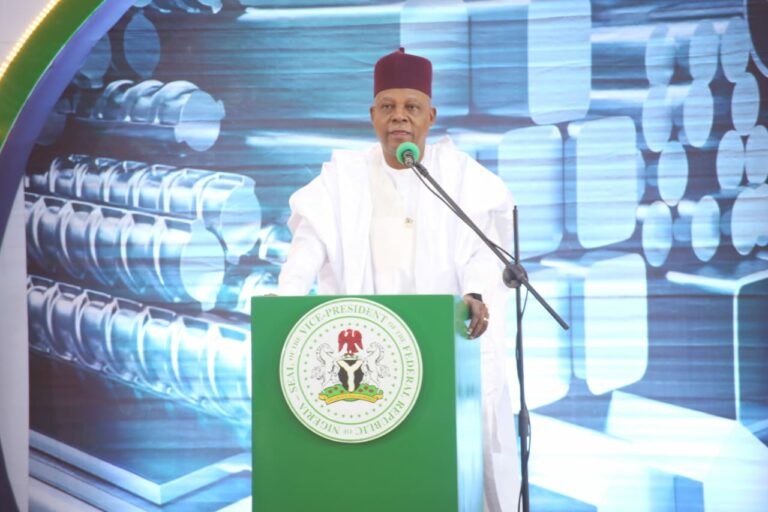
Vice President Kashim Shettima announced this on Friday at the National Policy Forum on the Institutionalisation and Implementation of the Renewed Hope National Home Grown School Feeding Programme, held in Abuja.
The forum was organized by the Presidential Committee on Economic and Financial Inclusion, in partnership with ActionAid Nigeria and various other stakeholders.
Speaking on behalf of the President’s Special Adviser on Economic Affairs, Office of the Vice President, Dr. Kolade Fasua, Shettima remarked that the expansion under President Bola Tinubu’s Renewed Hope Agenda represents the most ambitious effort to date in the history of this intervention.
READ MORE:
EPL: TOTTENHAM’S FRANK EXCLUDES UNCOMMITTED PLAYERS AFTER EZE SNUB
He explained that the programme, relaunched earlier this year, is designed to improve school enrollment and learning outcomes while creating a guaranteed daily market for smallholder farmers, women entrepreneurs, and local processors.
“This year, the federal government relaunched the Renewed Hope National Homegrown School Feeding Programme, signalling a decisive return to scale and systemisation. The programme is designed to boost enrollment and attendance, improve academic performance, and raise smallholder incomes through stable local procurement.
“Alongside the core programme, the government has inaugurated the Alternate Education and Renewed Hope School Feeding Project, an expansion that targets out-of-school and highly vulnerable children, with the ambition of reaching up to 20 million by 2026”, he said.
With the incorporation of the National Identity Management Commission system, Shettima emphasized that transparency would be guaranteed so that “genuine students receive authentic meals, and every naira spent yields benefits twice—once for the child, and once for the local economy. ”
While recognizing that maintaining nationwide coverage could amount to approximately one trillion naira, the Vice President contended that the initiative should not be perceived as a burden on public finances but rather as an investment in nation-building.
“Ambition necessitates investment, and the federal government has recognized that sustaining national coverage may require around one trillion naira.
“However, this should not be viewed as an expense. It is an investment in nation-building with substantial social, economic, and security returns. This is why the school feeding initiative must be perceived not solely as a social intervention but as a national security investment,” he asserted.
He noted that every hot meal provided in a classroom serves as a deterrent to recruitment into violent organizations, reinforces the state’s presence, and offers hope in communities prone to conflict.
“A child equipped with knowledge is less susceptible to exploitation. A farmer connected to a market is less prone to despair. Communities where youth are actively engaged are less vulnerable to insecurity.
“By incorporating MSMEs, women, and marginalized households into the financial framework, we diminish the shadows in which insecurity proliferates. When local markets flourish, when farmers witness assured demand, when cooks receive equitable and timely compensation, and when female micro-entrepreneurs build assets, the catalysts of conflict diminish,” Shettima articulated.
He urged development partners, private investors, and state governments to align with the federal government’s vision, highlighting that the success of the initiative would be assessed not just by hunger-free classrooms but also by safer, more resilient communities.
In his keynote address, the Minister of State for Humanitarian Affairs and Poverty Reduction, Dr. Tanko Sununu, represented by the Director of Social Development, Mr. Valentine Ezulu, advocated for a National Home Grown School Feeding Act to provide legal support for the program.
He further recommended the establishment of a nutrition guideline, in accordance with global best practices, to ensure safe and healthy feeding for children.
“We must strive to enact a National Home Grown School Feeding Act that assures continuity across political cycles while clearly delineating federal, state, and local roles within a cost-sharing framework.
“A National Nutrition Guideline for Home Grown School Meals, aligned with international best practices, must be established and enforced to ensure safe, balanced, and quality meals for every child,” Ezulu stated.


Happy
0 %

Sad
0 %

Excited
0 %

Sleepy
0 %

Angry
0 %

Surprise
0 %
 0
0
 0
0