
SAFETY EXPERTS DEMAND MANDATORY INSPECTION OF TANKER TRUCKS BEFORE PORT CLEARANCE
Read Time:3 Minute, 24 Second
By: Fasasi Hammad
The President of the Institution of Safety Professionals of Nigeria, Timothy Iwuagwu, has called for mandatory inspection and certification of tanker trucks before they are cleared from ports, citing concerns over vehicle design, mechanical faults and compliance with safety standards.
Iwuagwu also urged Nigerians to keep away from fallen fuel tankers and refrain from scooping spilled petroleum products, warning that exposure to highly flammable substances could trigger fatal explosions.
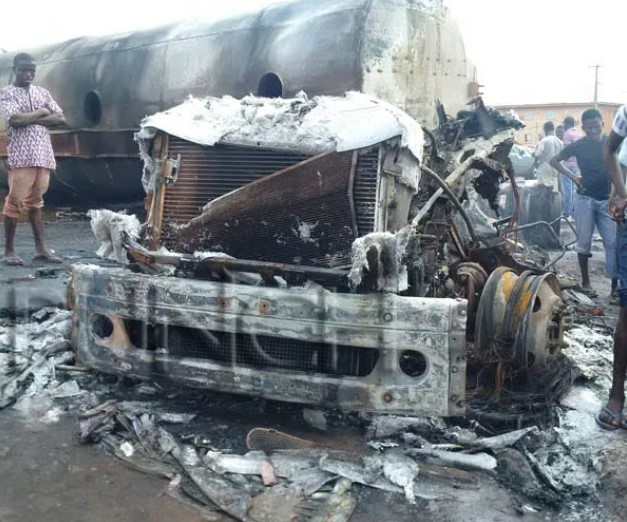
His warning follows a tanker explosion at Oluku Market in Benin City, Edo State, which left several people injured and destroyed properties, including two buses, an Audi saloon car, a truck and parts of the market.
Speaking on the dangers associated with fallen tankers, Iwuagwu said the immediate response should be for people around the accident scene to move to a safe distance.
“Whenever a tanker truck that is laden with volatile organic material falls, the first thing, the first reaction by people within that environment, is to keep away. Keep away from that; they are not to go closer to it,” he said.
He condemned the practice of approaching fallen tankers to collect spilled fuel, stressing that such behaviour could have deadly consequences.
According to him, petroleum products such as Premium Motor Spirit (PMS) are highly flammable, and even a small spark or electrostatic discharge could trigger an explosion.
He advised authorities to cordon off affected areas and prevent people from approaching accident scenes.
“The issue of people going to scoop the material that has spilled is the most foolhardy of all decisions,” he said.
Iwuagwu attributed tanker accidents to several factors, including poor safety compliance, faulty vehicle design and construction, inadequate inspections, poor road conditions and defects in critical components such as tyres, suspension and steering systems.
He explained that safety considerations must be incorporated into the design and construction of vehicles and their components, noting that imported tanker trucks should undergo proper inspections regardless of their country of origin.
“The design of a truck, whether it is imported from Europe or the United States or anywhere, it must be inspected. A lot of companies are even reluctant to allow safety professionals to look into some of these conveyances,” he said.
He questioned why the tanker involved in the incident released its contents after falling, arguing that the vehicle should have been designed to prevent such spillage.
He added that investigators should examine the condition of the roads, tyres, suspension and steering systems when determining the causes of tanker accidents.
According to him, uneven tyre pressure can destabilise a vehicle, while a faulty suspension system may reduce its ability to absorb shocks and maintain balance on the road.
To prevent future incidents, Iwuagwu called for stronger regulatory oversight, mandatory safety inspections and certification of imported tanker trucks before they are cleared by the Nigeria Customs Service.
He also urged vehicle inspection officers and road safety officials to prioritise the mechanical condition and roadworthiness of trucks rather than concentrating solely on vehicle documents.
“These trucks must be inspected and certified safe enough before the customs can give or get it cleared from the port from wherever it came in,” he said.
The safety expert further expressed concern over the different configurations and designs of trucks entering Nigeria, urging authorities to ensure that such vehicles meet appropriate safety requirements before being allowed on the roads.
Iwuagwu also advocated greater use of rail transportation for petroleum products, saying it would reduce the number of fuel tankers on highways and minimise the risks associated with transporting highly flammable substances by road.
“The best way to move these things is by rail. It’s by rail. The pipeline is a good method, is the newest of the transportation systems or modes,” he said.
He noted that transporting petroleum products by rail would reduce their interaction with populated areas and lower the risks posed by leaks and road accidents.
Iwuagwu also highlighted the importance of insurance coverage when transporting hazardous materials, warning that leaked fuel vapour could ignite when exposed to a flame source some distance away from the initial spill.


Happy
0 %

Sad
0 %

Excited
0 %

Sleepy
0 %

Angry
0 %

Surprise
0 %
 0
0
 0
0