
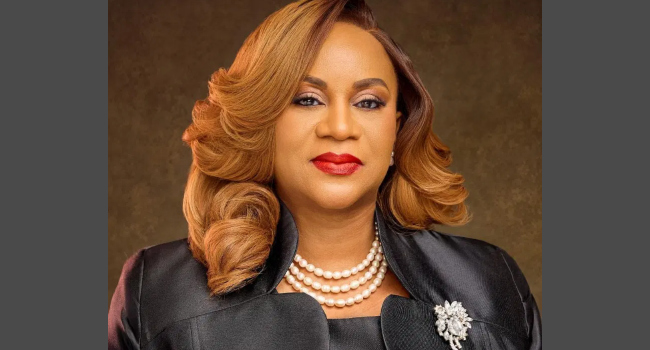
IWD 2026: FALCON CEO AUDREY URGES SUSTAINED DRIVE TO APPOINT WOMEN AS LEADERS IN ENERGY FIRMS
Read Time:3 Minute, 16 Second
BY :TAJUDEEN AMINAT
The Chief Executive Officer of Falcon Corporation Limited, Audrey Joe-Ezigbo, has urged stakeholders in Nigeria’s energy sector to strengthen efforts toward appointing more women to senior leadership roles, especially within the gas value chain, as the industry marks International Women’s Day 2026.
Audrey made the appeal as part of activities marking the global celebration of women’s social, economic and political achievements.
She noted the increasing number of female chief executives and managing directors emerging within Nigeria’s energy industry.
According to her, the development represents a significant shift in the sector’s leadership structure, which has traditionally been male-dominated. She also reflected on the notable strides recorded by women who have taken up top leadership roles in the energy sector in recent years.
Audrey further highlighted pioneering figures and key national energy leaders, including Olu Arowolo Verheijen, the Special Adviser to the President on Energy, whose policy advocacy has contributed to strengthening discussions on energy reforms and investment in the sector.
According to her, Oritsemeyiwa Amanorisewo Eyesan, the newly appointed Chief Executive Officer of the Nigerian Upstream Petroleum Regulatory Commission, marks a historic milestone in regulatory leadership and sends a strong message of inclusive governance in the energy sector.
She also commended the rise of prominent female energy leaders, including Folake Soetan, Managing Director of Ikeja Electric; Jennifer Adighije, Managing Director of Niger Delta Power Holding Company; Wola Joseph-Condotti, Interim CEO of Eko Electricity Distribution Company; Elozino Olaniyan, CEO of Midwestern Oil & Gas Company; as well as leading upstream figures such as Catherine Uju Ifejika of Brittania-U Nigeria Limited and Seinye Lulu-Briggs of Moni Pulo Limited.
Audrey emphasized that the readiness of boards and shareholders to promote women to top decision-making positions reflects the industry’s maturity and a growing acknowledgment that competence, discipline, and vision are not defined by gender.
“Each of these appointments sends a powerful message beyond boardrooms and balance sheets,” Audrey said. “It demonstrates that Nigeria’s energy sector is ready to compete globally by leveraging the full strength of its talent pool.”
“It sends a clear message to investors that governance and leadership appointments are increasingly based on merit. More importantly, it shows young girls that no part of the energy value chain is out of reach—not the control room, not the trading desk, not the executive suite.”
She praised organisations that have made what she called “bold and forward-looking decisions” by entrusting women with complex, capital-intensive operational responsibilities, noting that such actions enhance both institutional credibility and long-term sustainability.
Audrey highlighted that the gas sector, in particular, is at a critical juncture as Nigeria pushes forward its industrialisation and energy security goals through expanded domestic gas utilisation.
She stressed that expanding infrastructure must go hand in hand with leadership diversity for the sector to achieve sustainable and resilient growth.
“As we develop pipelines, scale up distribution networks, and invest in critical gas infrastructure, we must also cultivate leadership systems that embody inclusion and foresight,” she said. “Gas is central to Nigeria’s energy transition, and the leaders guiding that journey must reflect the nation’s diversity.”
Audrey added that this decade presents a unique chance to redefine expectations around who leads energy institutions. She urged boards, regulators, and investors to institutionalise inclusive succession planning rather than view female leadership appointments as isolated achievements.
“At Falcon, we regard inclusion not as a campaign slogan but as a core governance principle,” she said. “The progress we are seeing across the sector must not be episodic—it should be sustained, measurable, and irreversible.”
She concluded by noting that International Women’s Day 2026 provides the industry an opportunity not only to celebrate women’s accomplishments but also to consolidate momentum, ensuring the next generation of female engineers, economists, and energy executives inherit a sector driven by merit, opportunity, and equal access to leadership.


Happy
0 %

Sad
0 %

Excited
0 %

Sleepy
0 %

Angry
0 %

Surprise
0 %
 0
0
 0
0