
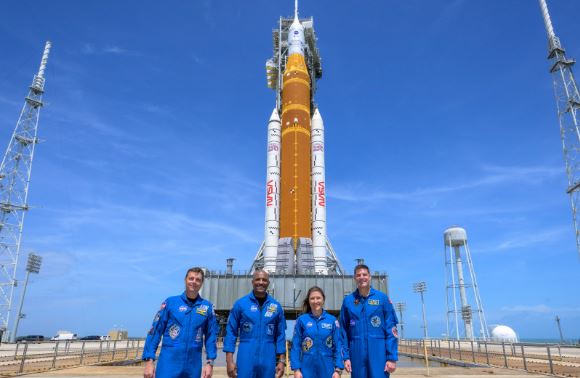
ARTEMIS II SET FOR HISTORIC MOON MISSION: FIRST MANNED FLIGHT IN OVER 50 YEARS
Read Time:1 Minute, 56 Second
By: Balogun Ibrahim
Artemis II marks NASA’s first crewed mission in the Artemis program, set to launch no earlier than April 2026. The mission will carry four astronauts—Reid Wiseman, Victor Glover, Christina Koch, and Jeremy Hansen—on a 10-day voyage around the Moon. It will also serve as the first test of Orion’s life support systems with humans aboard.
The first manned Moon mission in over five decades is set to launch on Wednesday at 18:24 local time (23:24 BST). More than 400,000 spectators are expected around Florida’s Kennedy Space Centre to witness the Artemis II crew embark on their 10-day lunar journey.
Eight-year-old Isiah described the event as “kind of cool,” while other visitors recalled the 1972 Moon landing. Although the four astronauts boarding the Orion capsule—Reid Wiseman, Victor Glover, Christina Koch, and Jeremy Hansen—will not land on the Moon, their historic mission has already generated widespread excitement.
NASA is set to send astronauts on a mission to the Moon aimed at advancing scientific knowledge, unlocking economic opportunities, and laying the groundwork for the first crewed missions to Mars. Artemis II will mark the first time humans fly aboard NASA’s SLS rocket and Orion spacecraft, testing the agency’s deep-space capabilities. The roughly 10-day mission is scheduled to launch no earlier than April 2026 from Launch Complex 39 at Kennedy Space Center in Florida.
During the first two days, the crew will perform initial system checkouts and manually test Orion’s handling near Earth before setting off for the Moon. Orion’s service module will provide the propulsion needed to escape Earth’s orbit, sending the astronauts on a four-day journey around the Moon’s far side in a figure-eight trajectory stretching more than 230,000 miles from Earth. At its farthest point, the crew will travel roughly 4,600 miles beyond the Moon, testing spacecraft systems and carrying payloads designed to study space radiation, human health and behavior, and space communications. The findings will support future exploration missions.
The mission will conclude with Orion’s high-speed reentry into Earth’s atmosphere and a splashdown in the Pacific Ocean off San Diego, where a NASA and Department of Defense recovery team will retrieve the crew and spacecraft.


Happy
0 %

Sad
0 %

Excited
0 %

Sleepy
0 %

Angry
0 %

Surprise
0 %
 0
0
 0
0