
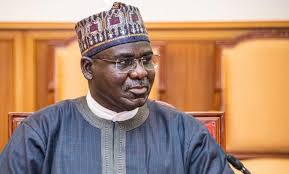
INSECURITY IN NIGERIA IS ‘POLITICAL’, SHOULDN’T BE SOLELY ENTRUSTED TO THE MILITARY – BURATAI
Read Time:2 Minute, 3 Second
BY JEN NOMAMIUKOR
A former Chief of Army Staff (CAS), Lt. Gen. Tukur Buratai (retired), asserts that insecurity in Nigeria is predominantly a political issue and cannot be addressed solely by the military.
During an appearance on television, Buratai asserted that addressing insecurity necessitates a comprehensive strategy that encompasses political, economic, and social measures, in conjunction with military initiatives.
He said, “The military is just one aspect of the overall national activity. We must get it very clear that apart from the military, we have the economic, social, and political lines. And we can see that from all indications the political line is that there’s no government present or in the past that does not want insecurity to be nipped or addressed properly, and resources have been earmarked and released for such.
“But you need to make sure that the social aspect and the underlying causes are all addressed. It’s not just a matter of relying completely, 100 per cent, on the military to solve the entire security challenges. There’s an underlying cause.
“It was started through some political actors, and it was essentially a political issue. This insecurity is essentially political. And now it’s been left to the military, and the political actors are staying behind.
“So, this is something that is needed for a total review of the security aspect in terms of political associations or political involvement and so on.”
Buratai also refuted assertions that the military is obstructing advancements in the struggle against insecurity, emphasizing that they remain “a remedy, not the issue. ” He urged Nigerians to endorse troops in the field, cautioning against measures that could dishearten soldiers who are risking their lives.
“We cannot continuously see the military as a problem to solving insecurity. They are the solution, one aspect of the solution. And they will play their role very well if they have good support,” he said.
“Any soldier that is on the field holding a weapon and standing before or in between himself and the people of Nigeria with the adversary is very important.
“You cannot demoralise him; if you demoralise him, or you despise him, or you make things difficult for him, then you are endangering his life and that of his family, and you are endangering the lives of the whole of Nigerians.”
“That is why we need to give them complete support to make sure they succeed on the field.”


Happy
0 %

Sad
0 %

Excited
0 %

Sleepy
0 %

Angry
0 %

Surprise
0 %
 0
0
 0
0