
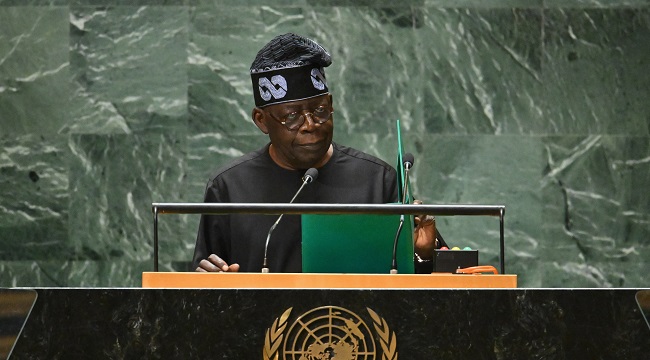
VIDEO: TINUBU DEMANDS TWO PERMANENT UN SEATS, VETO FOR AFRICA
Read Time:2 Minute, 19 Second
President Bola Tinubu has asked for at least two permanent seats for Africa on the United Nations Security Council, and he wants those seats to have veto power.He said the current setup of the Security Council doesn’t match how power is spread around the world today.
Tinubu made this request on Thursday during his speech at the General Debate of the 81st Session of the United Nations General Assembly in New York.
His speech, given by Vice President Kashim Shettima, also asked for five non–permanent seats for Africa on the Security Council.
He argued that changing the United Nations should start with reorganizing the Security Council. He said Africa can’t keep supporting the council‘s work without having a permanent voice in it.
“The reform of this institution must begin with the reconstitution of the Security Council, for the world of 2026 cannot remain captive to the distribution of power in 1945. Africa cannot continue to fill the Council’s agenda while remaining absent from its permanent membership. Nigeria demands, in accordance with the Ezulwini Consensus and the Sirte Declaration, at least two permanent seats for Africa, with all the rights and responsibilities of permanent membership, including the veto for as long as it exists, and five non-permanent seats in total. The authority to speak for humanity carries an obligation to represent it.”
Tinubu said Nigeria was prepared to take on greater responsibility in international peace and security, citing the country’s contributions to peacekeeping and mediation efforts across Africa.
He listed Nigeria’s involvement in Liberia, Sierra Leone, Darfur, Mali and The Gambia, adding that the country continued to advance mediation, democratic governance, counter-terrorism and maritime security through ECOWAS, the African Union and Gulf of Guinea partnerships.
On climate change, the President rejected what he described as a false choice between development and climate action, saying developing countries needed support to industrialise while reducing emissions.
“We reject the false choice between development and climate action. Developing countries must industrialise, eradicate poverty and expand energy access through low-carbon pathways supported by technology transfer, capacity building and climate finance.
“Africa contributes less than four per cent of greenhouse gas emissions, yet bears disproportionate consequences. Nigeria remains committed to the Paris Agreement and an equitable energy transition that reflects historical responsibility and capacity while protecting people’s right to development.”
Tinubu said Nigeria’s Energy Transition Plan was targeting net-zero emissions by 2060 while expanding access to affordable and reliable energy.
He said the plan combined renewable energy, clean cooking and gas as a transitional fuel with climate-smart agriculture and nature-based solutions.
The President also called for international climate finance to be based on equity and shared responsibility.


Happy
0 %

Sad
0 %

Excited
0 %

Sleepy
0 %

Angry
0 %

Surprise
0 %
 0
0
 0
0