
US-ISRAEL STRIKES DESTROY IRANIAN REVOLUTIONARY GUARD HQ; FIRST US CASUALTIES REPORTED
Read Time:2 Minute, 12 Second
Agency Report

Tensions escalated dramatically in the Middle East as US and Israeli forces destroyed the headquarters of Iran’s Revolutionary Guard, following coordinated strikes that killed Iran’s Supreme Leader Ayatollah Ali Khamenei. The campaign, which began Saturday, marks the deadliest phase of the conflict, with three US service members killed and five seriously wounded, the Pentagon confirmed.
US Central Command (CENTCOM) released video footage of missiles launched from a US Navy ship striking an urban compound in Tehran.
“America has the most powerful military on earth, and the IRGC no longer has a headquarters,” CENTCOM said on X.
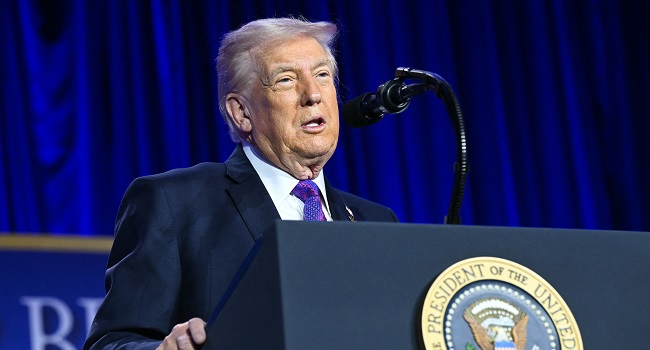
President Donald Trump indicated the military operation could continue for about a month, describing the campaign as “always been a four-week process.” He later acknowledged US casualties but maintained that the operation would be beneficial globally.
Iran responded immediately, launching missile and drone strikes across the Gulf and the wider Middle East, hitting Saudi Arabia, the UAE, Qatar, Bahrain, and Israel. Explosions were reported in several cities, including Tehran, as Iran’s Revolutionary Guards declared a “large-scale” retaliation.
Iranian officials condemned Khamenei’s killing as a “declaration of war against Muslims,” vowing revenge. President Masoud Pezeshkian said it was Iran’s “legitimate duty” to retaliate, while Ali Larijani, head of Iran’s Supreme National Security Council, promised unprecedented military response.
Meanwhile, Israel claimed significant success, with military spokesman Lt. Col. Nadav Shoshani reporting that the joint US-Israeli operation “eliminated 40 senior commanders, including Khamenei, in one minute.” Prime Minister Benjamin Netanyahu warned that attacks on Iran would escalate further, and Israel mobilized 100,000 reservists to reinforce readiness on multiple fronts.
Amid the chaos, Iran’s first retaliatory strikes killed at least four people and wounded dozens, while the UAE closed its embassy and withdrew its ambassador. The Red Crescent reported 201 fatalities in Iran with hundreds more injured, including top figures such as Ali Shamkhani and General Mohammad Pakpour of the Revolutionary Guards.
Concerns over civilian safety have prompted international advisories: the UK urged its citizens in the Gulf to shelter in place, the US mission in Jordan warned citizens to avoid embassies, and Bahrain advised avoiding hotels after one was damaged in a strike.
In Tehran, an interim leadership council, including Ayatollah Alireza Arafi and Pezeshkian, was announced to govern while a permanent successor to Khamenei is determined. The situation has sparked mixed reactions among Iranians—cheers at news of Khamenei’s death, alongside pro-government demonstrations chanting “Death to America!”
The unfolding crisis raises questions about regional stability, civilian safety, and the long-term political future of Iran as the US and Israel continue military operations.


Happy
0 %

Sad
0 %

Excited
0 %

Sleepy
0 %

Angry
0 %

Surprise
0 %
 0
0
 0
0