
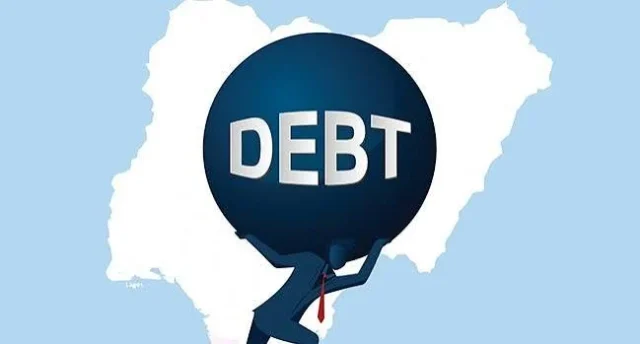
NIGERIA’S PUBLIC DEBT RISES TO N159.35TN IN MARCH 2026 — DMO
Read Time:5 Minute, 15 Second
By ‘Sefiu Ajape
Nigeria’s total public debt stock rose to N159.35tn at the end of March 2026, increasing by almost N10tn over one year, according to the latest figures released by the Debt Management Office.
An analysis of the DMO data showed that the country’s debt increased by N9.96tn, or 6.67 percent, from N149.39tn at the end of March 2025 to N159.35tn one year later.
In dollar terms, the increase was significantly higher at 18.22 percent, with the debt stock rising from $97.24bn to $114.95bn during the period.
However, the increase between December 2025 and March 2026 was relatively marginal in naira terms.
Total public debt rose by N75.51bn, or 0.05 percent, from N159.28tn in December 2025 to N159.35tn in March 2026. In dollar terms, the debt increased by $3.98bn, or 3.59 per cent, from $110.97bn over the same period.
The difference between the naira and dollar movements reflected changes in the exchange rate used by the DMO to convert foreign debt into local currency.
The agency used an official Central Bank of Nigeria exchange rate of N1,386.2156/$ for the March 2026 debt figures, compared with N1,435.2571/$ at the end of December 2025, representing an appreciation of about 3.42 per cent.
As a result, while Nigeria’s external debt rose slightly in dollar terms during the first quarter of 2026, its naira value declined significantly.
External debt stood at $51.90bn in March, up by $48.05m, or 0.09 per cent, from $51.86bn in December. However, its naira equivalent fell by N2.48tn, or 3.33 percent, from N74.43tn to N71.95tn.
The decline in the naira value of external debt was largely offset by increased domestic borrowing.
Total domestic debt increased by N2.55tn, or 3.01 percent, from N84.85tn in December 2025 to N87.40tn in March 2026.
Domestic debt consequently accounted for 54.85 per cent of Nigeria’s total public debt in March, compared with 53.27 per cent three months earlier, while external debt’s share declined from 46.73 per cent to 45.15 per cent.
The year-on-year figures showed an even stronger shift towards domestic borrowing.
Domestic debt rose by N8.64tn, or 10.98 per cent, from N78.76tn in March 2025 to N87.40tn in March 2026, increasing its share of total public debt from 52.72 per cent to 54.85 per cent.
External debt, by comparison, increased by only N1.32tn, or 1.87 percent, in naira terms over the same period.
However, in dollar terms, Nigeria’s external debt increased from $45.98bn in March 2025 to $51.90bn in March 2026, with the lower naira valuation reflecting the stronger exchange rate used for conversion.
The Federal Government remained the country’s largest domestic borrower.
FGN domestic debt increased from N80.49tn in December to N82.88tn in March, representing an increase of N2.39tn, or 2.97 percent, within three months. Compared with N74.89tn recorded in March 2025, it rose by N7.99tn, or 10.67 percent.
The Federal Government’s domestic debt alone accounted for 52.01 percent of Nigeria’s total public debt stock at the end of March 2026.
Domestic debt owed by the 36 states and the Federal Capital Territory also increased.
The stock rose by N163.25bn, or 3.74 percent, from N4.36tn in December to N4.52tn in March. Compared with N3.87tn recorded a year earlier, subnational domestic debt increased by N654.58bn, or 16.92 percent.
An analysis of the Federal Government’s domestic debt instruments showed that the first-quarter increase was driven mainly by Treasury Bills.
The outstanding value of Nigerian Treasury Bills rose by N2.71tn, or 19.60 percent, from N13.85tn in December 2025 to N16.57tn in March 2026.
Compared with N12.70tn in March 2025, Treasury Bills increased by N3.87tn, or 30.45 percent, over one year, accounting for 19.99 percent of FGN domestic debt.
FGN bonds remained the largest domestic debt instrument at N63.45tn, representing 76.56 percent of the Federal Government’s domestic obligations.
However, the amount was N179.25bn, or 0.28 percent, lower than the N63.63tn recorded in December, although it remained N3.66tn, or 6.12 percent, above the March 2025 figure.
The March 2026 bond stock comprised N39.46tn in conventional naira bonds, N22.72tn in securitised Ways and Means advances, and N1.27tn in domestic US dollar bonds.
While the securitised Ways and Means balance remained unchanged, the naira value of the domestic dollar bond declined from N1.32tn in December to N1.27tn in March due to exchange rate appreciation, even though the outstanding amount remained $917.41m.
Other domestic instruments recorded mixed movements.
FGN Sukuk remained unchanged at N1.19tn during the quarter but was N200bn, or 20.15 percent, higher than the March 2025 figure.
Savings bonds increased from N104.32bn in December to N116.21bn in March, while Green Bonds remained unchanged at N62.36bn during the quarter but were more than four times the N15bn recorded in March 2025.
Promissory notes declined by N158.78bn, or 10.28 percent, from N1.54tn to N1.39tn during the quarter but remained above their March 2025 level.
On the external debt profile, multilateral loans remained Nigeria’s largest category of foreign borrowing at $23.86bn, representing 45.96 percent of total external debt.
The International Development Association, the concessional lending arm of the World Bank, remained Nigeria’s single largest external creditor with $18.39bn outstanding.
Debt owed to the International Bank for Reconstruction and Development also increased.
Bilateral debt stood at $6.59bn in March, declining slightly from December but remaining above the March 2025 level.
China remained Nigeria’s largest bilateral creditor, while Eurobond debt remained unchanged during the quarter at $18.55bn, representing a 7.10 percent increase compared with March 2025.
Earlier, it was reported that the Federal Government increased its 2026 borrowing plan to N29.20tn following an expansion of the proposed budget.
The revised borrowing plan represents an increase of N11.31tn over the earlier N17.89tn projection contained in the 2026 Abridged Budget Call Circular issued by the Federal Ministry of Budget and Economic Planning.


Happy
0 %

Sad
0 %

Excited
0 %

Sleepy
0 %

Angry
0 %

Surprise
0 %
 0
0
 0
0