
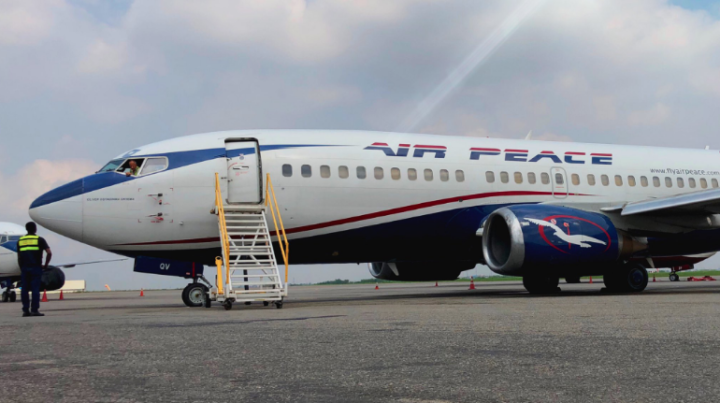
NSIB INDICTS AIR PEACE PILOTS FOR DRUG AND ALCOHOL USE AFTER PORT HARCOURT RUNWAY INCIDENT
Read Time:1 Minute, 37 Second
By Aishat Momoh. O.
The Nigerian Safety Investigation Bureau (NSIB) has indicted the pilot and co-pilot of an Air Peace aircraft for testing positive for alcohol and hard drugs following a runway excursion at the Port Harcourt International Airport on July 13, 2025.
This was disclosed in a preliminary report signed by the NSIB’s Director of Public Affairs and Family Assistance, Mrs. Bimbo Olawumi Oladeji, on Friday
The incident occurred when an Air Peace Boeing 737, carrying 103 passengers on a scheduled domestic flight from Lagos to Port Harcourt, veered off Runway 21 after an unstabilised final approach. The aircraft touched down 2,264 metres from the runway threshold and came to a stop 209 metres into the clearway. Fortunately, all passengers and crew disembarked safely, and no injuries were recorded.
READ MORE:
The NSIB report revealed that toxicological screening conducted on the crew at the Rivers State Hospital Management Department of Medical Laboratory, Port Harcourt, confirmed the presence of ethyl glucuronide an indicator of recent alcohol consumption in both the captain and first officer. A cabin crew member also tested positive for tetrahydrocannabinol (THC), the active compound in cannabis.
“These results are being reviewed under the human performance and safety management components of the investigation,” the NSIB stated, stressing that intoxication had now been identified as a contributing factor in the runway excursion.
Following the discovery, the bureau issued immediate safety recommendations to Air Peace, urging the airline to strengthen crew resource management training, particularly in handling unstabilised approaches and go-around decisions, and to reinforce internal procedures for crew fitness-for-duty monitoring before flight dispatch.
Runway excursions, the NSIB explained, are often caused by miscommunication, mistakes, equipment failure, or poor runway conditions. However, the findings in this case have added substance abuse to the list of critical risk factors in aviation safety.


Happy
0 %

Sad
0 %

Excited
0 %

Sleepy
0 %

Angry
0 %

Surprise
0 %
 0
0
 0
0