
WITNESS TELLS COURT NNAMDI KANU’S ESN LACKS LEGAL BACKING, UNLIKE AMOTEKUN
Read Time:2 Minute, 32 Second
By Aishat Momoh. o.
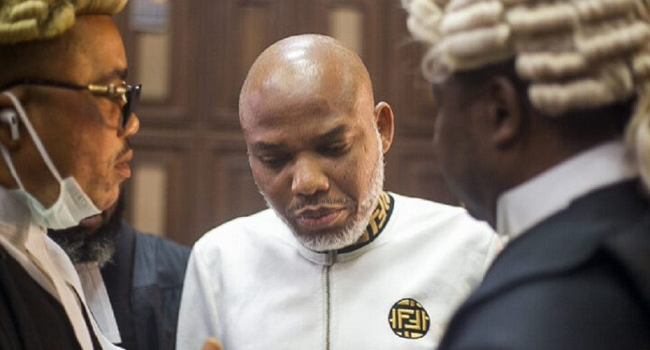
The Federal High Court in Abuja resumed hearings in the ongoing trial of Nnamdi Kanu, leader of the proscribed Indigenous People of Biafra (IPOB), with the second prosecution witness asserting that the Eastern Security Network (ESN), allegedly established by Kanu, is an illegal organization.
Testifying under the codename “BBB,” the witness told Justice James Omotosho that unlike Amotekun—a regional security outfit in the South-West created by laws passed by state legislatures—the ESN lacks any legal foundation.
During re-examination by prosecution counsel Adegboyega Awomolo (SAN), the witness stated that Amotekun’s legitimacy stems from its formal establishment by the Houses of Assembly in the six South-West states. In contrast, the ESN, he said, was formed without the backing of any Nigerian law.
He further explained that the Director-General of the Department of State Services (DSS) had previously advocated for community-based policing, but only under the strict guidance and approval of established security agencies.
Earlier in the proceedings, defence counsel Paul Erokoro (SAN) submitted three video recordings contained in a flash drive, which were admitted into evidence and played in open court.
One of the videos featured the DSS DG speaking at a public forum, calling on communities to serve as the first line of defence against insecurity—though he emphasized that any such efforts must be coordinated and approved by security agencies.
When asked by Erokoro if the DG was effectively encouraging civilian armament, the witness clarified that the recommendation was conditional upon supervision by the relevant authorities.
Another video showed former Minister of Defence, General Theophilus Danjuma, alleging that certain members of the Nigerian armed forces were complicit in ongoing killings. When asked to interpret the implications of Danjuma’s statement, the witness declined, saying only Danjuma could speak to his comments.
A third video showed Imo State Governor Hope Uzodinma attributing violence in the state to unnamed politicians. In response to Erokoro’s challenge—questioning whether this contradicted the DSS claim that IPOB was behind the killings in Orlu, the witness insisted that DSS findings had identified IPOB members as suspects and provided names of victims, while the governor had not offered such details.
The witness also confirmed that IPOB remains a proscribed organization and that Kanu continued to be a member before and after the proscription.
On the #EndSARS protests, the witness agreed that the demonstrations were driven by calls to disband the Special Anti-Robbery Squad (SARS), and acknowledged that panels of enquiry including in Lagos, were established to probe the protests. He admitted that the Lagos panel’s report did not list IPOB as participants or categorize the protests as terrorism.
Erokoro tendered the Lagos commission’s report into evidence, and it was accepted by the court.
Justice Omotosho directed the prosecution to close its case within six days, while allotting nine days for the defence to present its arguments. With both parties in agreement, the court adjourned the trial to May 28 and 29, and June 6, 16, 18, and 19 for continuation.


Happy
0 %

Sad
0 %

Excited
0 %

Sleepy
0 %

Angry
0 %

Surprise
0 %
 0
0
 0
0