
INDIA, EU SEAL “MOTHER OF ALL DEALS” IN LANDMARK TRADE PACT AFTER 20 YEARS OF TALKS
Read Time:2 Minute, 43 Second
By Aishat Momoh. O.
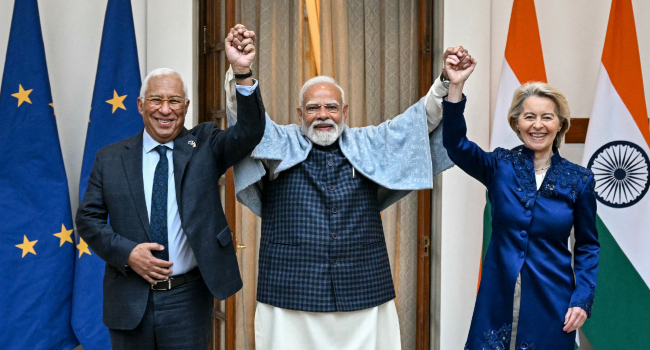
India and the European Union on Tuesday announced a landmark free trade agreement dubbed the “mother of all deals,” creating a combined market of nearly two billion people after two decades of negotiations.
Indian Prime Minister Narendra Modi and EU leaders said the pact is aimed at boosting economic ties and shielding both sides from growing global challenges posed by the United States and China.
Under the agreement, tariffs on almost 97 per cent of European exports to India will be cut or eliminated, saving European companies up to €4 billion ($4.75 billion) annually, according to the 27-member bloc.
“A mother of all deals,” Modi declared during talks in New Delhi with European Commission President Ursula von der Leyen and European Council President Antonio Costa.
“This deal will bring many opportunities for India’s 1.4 billion people and millions across the European Union,” Modi said, noting that the agreement covers about 25 per cent of global GDP and one-third of global trade.
Von der Leyen described the pact as historic, saying, “Europe and India are making history today. We have created a free trade zone of two billion people, with both sides set to benefit.”
EU officials said the agreement is the most ambitious trade deal India has ever signed, offering European firms a “first-mover advantage,” particularly in agriculture, automotive manufacturing, and services.
Bilateral trade in goods between India and the EU reached €120 billion ($139 billion) in 2024 — a nearly 90 per cent increase over the past decade — with an additional €60 billion ($69 billion) in services trade.
As part of the deal, India will significantly reduce tariffs on key European products. Import duties on cars will gradually fall from as high as 110 per cent to as low as 10 per cent, while tariffs on wines will drop from 150 per cent to about 20 per cent. Duties on processed foods such as pasta and chocolate will be eliminated.
European firms will also gain enhanced access to India’s financial services and maritime transport sectors. Von der Leyen said EU exports to India are expected to double under the agreement.
READ MORE…
MTN JOINS LAGOS STATE IN BUILDING BUS PARK AT OBALENDE UNDER-BRIDGE
For India, the deal is expected to boost exports of textiles, gems and jewellery, leather goods, and services, while attracting European technology and investment to support infrastructure development and job creation.
Negotiations reportedly went down to the wire on Monday, with sensitive issues such as the EU’s carbon border tax on steel among the final sticking points.
The agreement comes as both India and the EU seek to diversify trade ties amid US tariffs and Chinese export controls. The two sides are also expected to finalise separate agreements on labour mobility, as well as security and defence cooperation.
“India and Europe have made a clear choice — the choice of strategic partnership, dialogue, and openness,” von der Leyen said. “We are showing a fractured world that another way is possible.”
India is projected by the International Monetary Fund to become the world’s fourth-largest economy this year, as it continues efforts to reduce reliance on traditional partners and strengthen domestic manufacturing.


Happy
0 %

Sad
0 %

Excited
0 %

Sleepy
0 %

Angry
0 %

Surprise
0 %
 0
0
 0
0