
SENATE ENDORSES FRSC MODERNISATION, URGES INCREASED NIPSS FUNDING
Read Time:2 Minute, 50 Second
By: Balogun Ibrahim
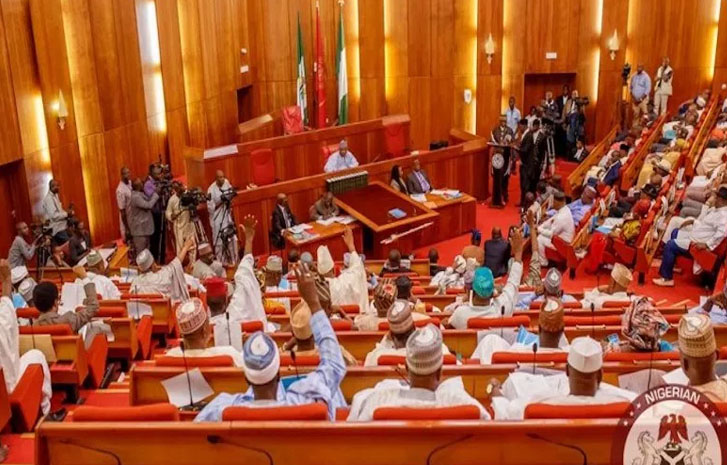
The Senate has emphasised the importance of continuous training, capacity development and improved safety programmes for officers of the Federal Road Safety Corps (FRSC), noting that sustained professional development is essential for effective road safety management nationwide.
This position was made known on Wednesday during the FRSC’s 2025 budget performance review and the consideration of its 2026 budget proposal by the Senate Committee on Federal Character and Inter-Governmental Affairs.
Speaking at the session, the committee’s chairman, Senator Allwell Onyesoh, said the modernisation of training structures within the Corps was imperative for Nigeria to respond effectively to emerging road safety challenges, new technologies and international best practices.
In a statement issued by his Special Adviser on Publicity and Communications, Peter Oriri, Onyesoh stressed that a well-structured and continuous retraining system would enhance discipline, boost operational efficiency and improve service delivery across the country.
He stressed that the Federal Road Safety Corps must entrench regular training and retraining programmes for its personnel, noting that road safety administration is constantly evolving and requires officers to be equipped with modern skills, technology-based knowledge and global best practices to effectively address emerging challenges.
Meanwhile, the Corps Marshal of the FRSC, Shehu Mohammed, revealed during his presentation that the agency generated more than ₦4 billion in revenue in 2025.
He attributed the revenue to proceeds from fines, number plate registrations and drivers’ licence fees, adding that the figures reflect improved enforcement strategies and higher levels of compliance.
The committee commended the Federal Road Safety Corps for its improved professionalism and timely response to road safety issues, despite prevailing funding constraints, but stressed that continuous training and retraining of serving officers remains essential to achieving global standards in accident prevention and rescue operations.
Meanwhile, for the 2026 fiscal year, the FRSC proposed a total budget of ₦129 billion, comprising ₦99,737,554,653 for personnel costs, ₦26,964,914,587 for overhead costs and ₦2,425,987,544 for capital expenditure.
The Committee also examined the 2026 budget proposal of the National Institute for Policy and Strategic Studies (NIPSS), presented by its Director-General and Chief Executive Officer, Ayo Omotayo.
The Institute requested a total budget of ₦4,016,023,688 for the 2026 fiscal year.
After deliberations, the Committee called for increased funding to ensure effective implementation of NIPSS programmes and urged the Institute to continue its ongoing reforms despite existing challenges.
The Committee further recommended that NIPSS reconsider its age requirements to allow younger applicants the opportunity to develop their policy knowledge and leadership skills.
On the importance of inclusivity and generational renewal in policy-making, Senator Allwell Onyesoh stated: “While maintaining the Institute’s standards and traditions, it is crucial to revisit certain age criteria to make space for younger, talented Nigerians who are eager to contribute fresh perspectives to national policy and strategic development.”
The Office of the Secretary to the Government of the Federation, represented by David Eze on behalf of the Secretary, presented a proposed budget of ₦22,294,833,817 for 2026.
The budget is divided into ₦7,128,078,895 for personnel costs, ₦8,716,435,372 for overhead costs, and ₦6,450,319,550 for capital expenditure.
Committee members present at the session included Senate Minority Leader Abba Moro, Adams Oshiomhole, Victor Umeh, Amos Yohanna, Binos Yaroe, Kelvin Chukwu, Osita Ngwu, and the Committee’s Vice Chairman.


Happy
0 %

Sad
0 %

Excited
0 %

Sleepy
0 %

Angry
0 %

Surprise
0 %
 0
0
 0
0