
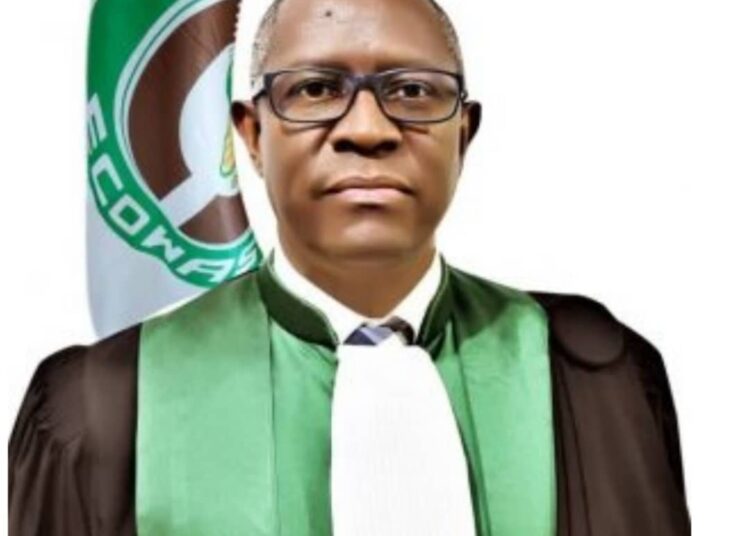
ECOWAS COURT PRESIDENT URGES MEMBER STATES TO ENFORCE JUDGMENTS AS LAGOS MEETING HIGHLIGHTS REFORM STRATEGIES
Read Time:3 Minute, 17 Second
By Aishat Momoh. O.
President of the ECOWAS Community Court of Justice, Justice Ricardo Gonçalves, has urged member states to intensify efforts towards enforcing the Court’s judgments, describing the current compliance rate as “unacceptably low.”
He made the appeal on Tuesday during the closing session of the inaugural meeting of Competent National Authorities, held at the Federal Palace Hotel in Lagos.
The two-day meeting, themed “Enhancing the Role, Relevance, and Effectiveness of the ECOWAS Court of Justice: Strengthening Synergies Between the Court and Competent National Authorities,” brought together Attorneys General, Ministers of Justice, legal experts, and senior representatives from across West Africa.
In his remarks, Justice Gonçalves stressed that the authority of the Court derives from Article 15(4) of the ECOWAS Revised Treaty, which makes its judgments binding on member states, institutions, individuals, and corporate bodies. He also referenced the principle of pacta sunt servanda, urging countries to honour their treaty commitments in good faith.
“The effectiveness of the ECOWAS Court of Justice hinges on the goodwill and commitment of Member States,” Gonçalves stated. “We must ensure our judgments are not merely symbolic, but are effectively translated into real and lasting justice for the peoples of our region.”
He called on countries that have yet to designate a Competent National Authority, as required under Article 24(4) of the Court’s Supplementary Protocol, to do so without delay. He also highlighted the continued challenge posed by the lack of domestication of ECOWAS legal instruments, particularly in common law jurisdictions, which hampers enforcement.
Gonçalves commended the collaborative spirit of the Lagos gathering and reaffirmed the Court’s role as a cornerstone of regional integration and rights protection. “May our shared commitment to justice and cooperation continue to inspire and guide our work in the years ahead,” he concluded.
The meeting marked a significant milestone as the first formal assembly of national enforcement authorities across the ECOWAS region, convened to devise strategies for improved judgment enforcement and institutional accountability.
Representing Nigeria’s Federal Ministry of Justice, Director of International and Comparative Law, Mr. Nnanna O. Ibom, underscored the critical role of implementation. “Implementation is the only way to enthrone the rule of law within the ECOWAS region,” he said. “As we return home, we must take deliberate steps to act on the recommendations we’ve adopted here.”
Also addressing the gathering, Mr. Gaye Sowe, Acting Deputy Chief Registrar and Registrar in charge of Appeals, Arbitration, and Enforcement, outlined new initiatives by the Court to strengthen engagement, improve compliance, and streamline reparations for victims of rights violations.
Sowe revealed that only 10 out of 12 ECOWAS member states have designated competent national authorities, noting that communication gaps remain a key obstacle to enforcement. “Timely and effective communication is critical,” he said. “The Court is actively working to bridge this gap and enhance engagement with enforcement stakeholders.”
To this end, he disclosed that the Court is developing comprehensive guidelines for awarding reparations and has commenced direct consultations with national authorities to clarify procedures and address bottlenecks.
“These face-to-face interactions allow us to understand enforcement challenges and provide technical support where necessary,” Sowe added, emphasizing that strong relationships with member states, judiciaries, and civil society are vital for the Court’s mandate.
“The enforcement of decisions is not solely a legal question; it is also institutional,” he noted. “Strong, respectful relationships between the Court and Member States will help close the gap between judgment and justice.”
Since its establishment, the ECOWAS Court has delivered more than 400 judgments on issues ranging from arbitrary detention and torture to discrimination, civil liberties, and socio-economic rights. Nigeria accounts for approximately 125 of these decisions, making it the most litigated country before the Court.
Sowe praised the active role played by Nigerian individuals and civil society groups in advancing the Court’s human rights jurisprudence and expressed optimism about the future of enforcement reforms through sustained dialogue and cooperation.


Happy
0 %

Sad
0 %

Excited
0 %

Sleepy
0 %

Angry
0 %

Surprise
0 %
 0
0
 0
0