
WE DON’T DRINK ALCOHOL, SMOKE MARIJUANA — INDICTED AIR PEACE CO-PILOT, CABIN CREW REJECT NSIB REPORT
Read Time:11 Minute, 34 Second
Agency report
A co-pilot, David Bernard, and a cabin crew member, Maduneme Victory, have rejected a Nigerian Safety Investigation Bureau (NSIB) report that said they tested positive for alcohol and a hard drug.
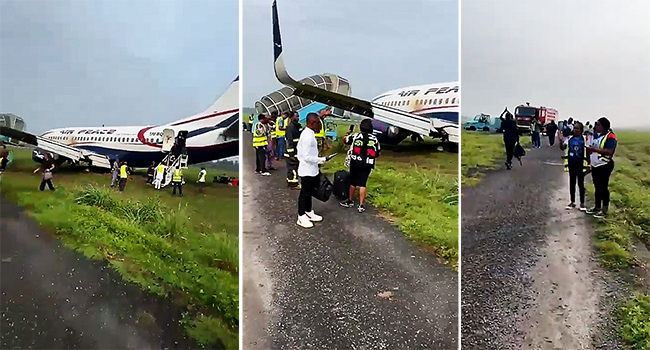
The NSIB said toxicological tests on the flight crew returned positive results for alcohol and marijuana after the Air Peace aircraft they were on veered off the runway while landing at Port Harcourt International Airport during a runway incursion on Sunday, July 13, 2025.
The bureau’s preliminary findings stated the aircraft touched down 2,264 metres from the runway threshold — well beyond the recommended touchdown zone — and eventually stopped 209 metres into the clearway.
Although everyone on board disembarked safely, the incident prompted immediate safety concerns.
An aircraft incursion is the wrongful or unauthorised positioning of an aeroplane at the runway.
Incursions are most caused by miscommunication, mistakes, faulty gear and potholes on runways, among others.
The NSIB preliminary report, signed by the Director of Public Affairs and Family Assistance at Nigerian Safety Investigation Bureau, Mrs Bimbo Oladeji, seen by Hotjist on Saturday, said toxicological test results conducted on the flight crew turned out positive.
The tests indicated the presence of alcohol in the system of the crew, while another crew member also tested positive for tetrahydrocannabinol (THC), the active compound found in cannabis, colloquially referred to as “India hemp.”
The statement further read, “Initial toxicological tests conducted on the flight crew revealed positive results for certain substances, including indicators of alcohol consumption. “A cabin crew member also tested positive for THC, the psychoactive component in cannabis. These results are being reviewed under the human performance and safety management components of the investigation.
“Toxicological test was conducted on the flight crew at Rivers state hospital management, department of medical laboratory, Port Harcourt, on 13th July 2025 and they tested positive for some substances. Toxicological screening conducted post-incident revealed: captain and first officer: tested positive for Ethyl Glucuronide, indicating recent alcohol consumption.”
Co-pilot, crew member kick back
Speaking on Arise Television on Friday, Bernard and Victory accused the NSIB of using questionable testing procedures at an unregistered facility and said the agency’s findings were damaging to the airline’s reputation.
Bernard insisted he neither drinks alcohol nor uses drugs, and questioned the testing process used after the incident.
“I don’t drink and secondly, we are in 2025, if you are trying to do an alcohol and blood test, we have something called the breathalyser, where you have to do your test right there. You blow in your breathe into the breathalyser. It checks the amount of alcohol in your system.
“But these guys at the Port Harcourt Airport took our blood samples and urine on the 13th and then, they are coming back on the 23rd of July with the result. I mean, how long does it take for a result to be out?
“We are in 2025 and we paid a lot of money for this flying school. You can’t just jeopardise somebody’s image, telling me I take alcohol. I didn’t see it in your presence. You took the test out to a non-aviation recognised hospital. So, it doesn’t make any sense at all. I don’t drink or smoke,” he said.
Bernard also pointed out that the airline routinely conducts random tests on crew members and told passengers such checks encourage crew to avoid anything that might put their jobs at risk. He added: “So, you don’t just take anything because you can randomly be checked when reporting for duty. And you are not supposed to have 0.02 grams of alcohol in your blood and you are not supposed to take alcohol eight hours before reporting on duty or on standby.”
Victory similarly condemned the NSIB results as an attempt to tarnish Air Peace’s image and described discrepancies in how the tests and results were handled.
She said, “On July 13th, after we landed, we waited for NSIB to come on board. Then they came and started their investigation. And five hours later, they asked us to come into a room to do a test.
“So, we all went into the room and our blood samples were taken and our urine was also taken. Normally, when this kind of test is done, immediately after a drug test and alcohol test, you are supposed to get your results within a few hours. But this was not given to us that day. 10 days later, on the 6th, I was called by the NCAA to come and pick up a letter,” she recounted.
According to her, the letter came as a shock.
“I went to the NCAA in Lagos, I opened the letter and I was in utter shock to see what was in my result. So, I went to see the doctor. I told the doctor that I was very shocked to see this in my result and it is not possible for me to have this in my system. And he told me to come back in seven days to reply to their letter, but I didn’t wait until seven days; I had to respond, which was on the 7th.
“They got back to me on the 27th that I should come to the office. I went to the office and I was handed a letter and the letter said I should do a reconfirmatory test, which I accepted to do and they sent to me to go and meet Dr Adetunji of Aero Space Clinic, which is the licensed clinic for this kind of test.
“When I met with the doctor, he said to me that marijuana usually stays in the system for 90 days. That if I have something like this that he is advising me that I should go and come back later when I feel like everything has cleared from my system. I said no, if I go back and come back later, it actually proves that I have this kind of thing in my system. I want to do the test.
“The test was done and everything came out negative. The question I need to ask NSIB is, if marijuana was found in my system, were they not supposed to say this to my airline, and were they not supposed to stop me from flying?
“Why? Because I am a risk to the passengers on board and my license would have been taken away from me. But they didn’t inform them of this till after two months. This is like the second month and it is just coming out and they are spoiling the image of the airline.
“This thing (test) was done within a month. And nothing was found in my system. If NSIB have a smiring campaign against the airline, they should keep the innocent people away from this. If not for the calmness of my chairman, they would have sacked me and blacklisted me. And once that is done, no airline in the world would pick me because now they have painted me as this person who has a drug in her system. This is really very bad,” she added.
She threatened to take legal action against the agency if the report was not withdrawn.
“This is really very bad. This is pure defamation of character. I don’t know if our report and test should be shown because the world needs to see this and NSIB needs to come and actually clear this thing. We just woke up this morning and all this news is flying around. I wish we could just pursue this and let the world see that this is our test result and nothing is found in our system. These are all lies.”
NSIB response, Air Peace position
But NSIB Director-General Captain Alex Badeh rejected claims of a smear campaign, saying the reaction was expected from those “in the eye of the storm.”
He said, “We have heard them say it is a smear campaign against the airline. But I must point out that this is not our first preliminary report we’ve published. We have published countless. So, it is a little surprising to suddenly hear that it is a smear campaign against Air Peace. NSIB does not conduct test. This was done by the River State Hospital Management but it is an official test. They got tested, urine and blood and the report came out the next day, on the 14th, the crash happened on the 13th. So, the report was with us but we had to investigate other things.”
Air Peace, in its response to the controversy, noted that the co-pilot had been cleared by the Nigerian Civil Aviation Authority (NCAA) and had returned to active duty.
“If he were involved in drug or alcohol use, the Nigerian Civil Aviation Authority would not have cleared him to resume flight duties,” the airline said.
The carrier also said that if the captain were eventually confirmed to have tested positive for alcohol, it would increase the frequency of crew testing and strengthen internal fitness-for-duty checks and monitoring.
Efforts to reconcile the NSIB’s position with the NCAA’s apparent clearance had not yielded a resolution by the time this report was filed. The Director of Public Affairs and Consumer Protection at the NCAA, Michael Achimugu, said he would confirm and revert to the correspondent but had not responded by press time. Repeated calls and a text message to the NSIB spokesperson went unanswered.
Watchers have questioned whether Nigeria’s aviation agencies are working in concert or operating in silos.
Air Peace added that before the NSIB published its report, the bureau had not officially communicated its toxicology findings to the airline.
“We are yet to receive any official communications from the NSIB on such findings over a month after the incident and after the testing of the crew for alcohol which took place in less than an hour of the incident! As a responsible airline, we place utmost priority on safety, transparency, and compliance, and it is important to set the record straight.
“Air Peace conducts frequent alcohol and drug tests on our crew. We have a very strict alcohol use policy that is stricter than the 8 hours before the flight as provided in the regulations. Drug use is a NO-NO!
“Following the incident, we took immediate and decisive action: The captain of the affected flight was grounded and relieved from further flight duty till date for failure to adhere to Crew Resource Management principles and for disregarding standard go-around procedures as advised by his co-pilot but not for testing positive to breathalyser test as the result was not communicated to us by NSIB to date,” Air Peace explained.
Public alarm, expert critique
The episode has fuelled public anxiety about aviation safety and prompted calls for clearer enforcement of rules governing airlines and regulators.
A frequent flyer, Aderoju Aina, said the issue must be taken seriously, pointing to similar incidents in other countries.
“Just recently, I watched a clip of a pilot who was discovered to be drunk and was whisked away by the FBI. Human beings are the same everywhere in the world but our disciplines vary. My greatest fear is that everything goes in Nigeria and that is why I am afraid for my life right now.
“I don’t mind speaking to pilots to confirm their current mental stability or even smelling their mouths before embarking on a trip going forward, please.”
Another passenger, who gave her name as Maria, said the news had prompted her to consider travelling by road instead of air for a planned trip.
“I am supposed to fly to Abuja with my friend tomorrow. She has insisted that we would rather leave today to go by road because the news of the ‘drinking or drunk pilot’ has caused panic in everybody.
“But my only appeal to the Nigerian government or whoever is in charge of issues like this is that this should be followed to a logical end and not just be put in the past. That is why the other countries are ahead of us, it is not magic, all they do is due diligence and that is what I am also asking for.”
Industry veteran Group Captain John Ojikutu (Rtd) faulted the NCAA for lax enforcement and warned of a loss of institutional knowledge within the regulator.
“They are now losing experienced hands and are not even willing to train replacements. That’s dangerous,” he said.
He added that a previous intervention had uncovered “over 150 unaddressed safety recommendations.”
“We were called in to help and we found that these issues had simply been ignored. The NCAA must sit up and they have no option.”
Referencing past incidents, Ojikutu argued that authorities once took a more proactive stance under former Director General Dr Harold Demuren.
Ojikutu said, “In the days of Demuren, critical issues can’t be swept under the carpet. There was a pilot who crashed some time ago because he was rushing to catch another flight to travel out of the country. Many of these things are known but what are we doing to them? If truly the pilot was drunk, why was it that nobody detected that?
“Just like Dana Air that crashed in Lagos some time back. I gathered that the incident started 17 minutes after taking off from Abuja and he was either supposed to turn back or land at the nearest airport, whichever is closer but the pilot continued and crashed in Iju. A few weeks later, a similar one happened with Aerocontractors.”
As the investigation continues, passengers, experts and industry insiders are urging aviation authorities to resolve the contradictions in the public record and clarify procedures so confidence in Nigeria’s skies can be restored.


Happy
0 %

Sad
0 %

Excited
0 %

Sleepy
0 %

Angry
0 %

Surprise
0 %
 0
0
 0
0