
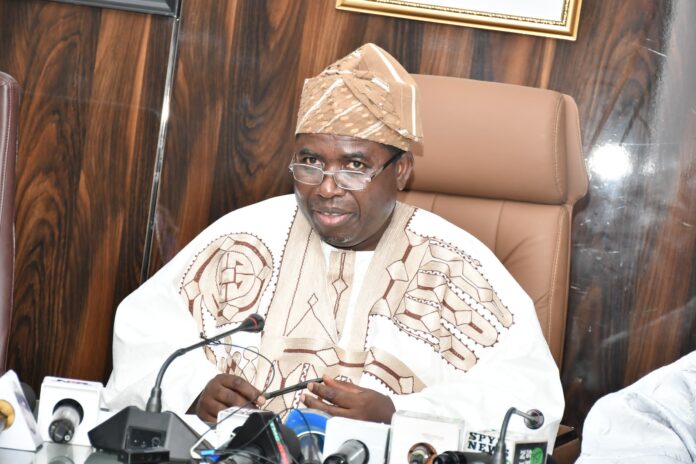
INEC TO UNVEIL REVISED TIMETABLE FOR 2027 GENERAL ELECTIONS
Read Time:7 Minute, 50 Second
Agency report
The Independent National Electoral Commission (INEC) has said it will review the Electoral Act 2026 to ensure compliance with legal provisions governing preparations for the 2027 general elections.
The Chief Press Secretary and Media Adviser to the INEC Chairman, Prof. Joash Amupitan, Mr. Adedayo Oketola, disclosed that the commission would release a “revised timetable,” although he did not specify when it would be announced. He maintained that the electoral body remained committed to operating strictly within the law.
Oketola made the clarification in an interview with Sunday PUNCH while responding to calls by some political parties for the release of a fresh election timetable.
Leaders of several political parties told correspondents that a new timetable had become necessary following the enactment of the Electoral Act 2026, noting that adequate scheduling was required to enable parties organise primaries and other internal processes ahead of the polls.
INEC had earlier announced that presidential and National Assembly elections would be held on February 20, 2027, while governorship and state Houses of Assembly elections were fixed for March 6, 2027.
The announcement attracted criticism from some sections of the public, particularly Muslim groups, who argued that the dates coincided with the Ramadan fasting period.
Amid the debate, the National Assembly passed the Electoral Act 2026, reducing the mandatory notice period for elections from 360 days to 300 days. The amended Clause 28 provides that INEC “shall, not later than 300 days before the day appointed for the holding of an election under this Act, publish a notice in each state of the Federation and the Federal Capital Territory—(a) stating the date of the election; and (b) appointing the place at which nomination papers are to be delivered.”
The amendment is expected to give the commission greater flexibility in fixing dates for the 2027 presidential and National Assembly elections, potentially shifting them to a window between late December 2026 and January 2027.
Legal experts have argued that INEC cannot continue preparations under the amended 2022 Electoral Act, stressing that electoral processes must align with the new law.
A Senior Advocate of Nigeria, Mr. Femi Falana, said the commission was legally required to issue another timetable, stating, “There must be a new timetable in line with the new electoral act. That is the place of law,” he said.
Another senior constitutional lawyer, who spoke on condition of anonymity, explained that once a new law takes effect, it overrides existing frameworks. According to him, INEC could not legally rely on a timetable based on a repealed statute.
“If the Electoral Act 2026 has altered the notice period and related submission windows, then, as a matter of constitutional compliance, the commission must realign its timetable. Anything short of that invites a legal challenge,” he said.
He further noted that election timetables are legal instruments derived directly from statutory provisions and must reflect any amendments to the law.
“The timetable is a derivative of the Act. If the Act changes, the derivative instrument must also change. Otherwise, you create a conflict between statutory law and administrative action. That is precisely the kind of inconsistency that courts are quick to strike down.
“This is not about whether INEC prefers to adjust or not. It is about legality. A compressed notice period of 300 days instead of 360 automatically shifts the permissible window for party primaries, candidate submission, and regulated campaigning.
“Even if the commission attempts to retain earlier administrative dates, those dates must fall squarely within the new statutory parameters. If they do not, affected parties will challenge them.”
The lawyer warned that failure to promptly adjust the timetable could trigger pre-election litigation.
“Political actors are highly sensitive to timing. If one party believes another gained advantage from a timetable not strictly aligned with the new law, the courts will be approached immediately.
“Once litigation begins, operational certainty suffers. It is far safer for INEC to review and publicly reissue a harmonized calendar than to defend avoidable lawsuits.
“Electoral stability depends on predictability, but predictability must rest on lawful foundations. The safest institutional path is transparency: acknowledge that the legal framework has changed, adjust the timetable accordingly, and communicate clearly with stakeholders. In my professional opinion, a revised timetable is not optional; it is imminent if the new law is to be faithfully implemented,” he added.
Similarly, a senior official of the All Progressives Congress said a new timetable was expected soon, noting that all electoral processes must now be conducted under the Electoral Act 2026.
“We (APC) are expecting them to do that anytime soon, so that they will not run foul of the new electoral law, which gives specific days for the notification and conduct of elections,” the official said.
Political parties also cautioned that delays in issuing a revised timetable could disrupt internal planning.
The National Publicity Secretary of the African Democratic Congress, Bolaji Abdullahi, said INEC must act quickly to enable parties organise congresses and conventions without violating statutory timelines.
“INEC will probably come up with a new election timetable, but there are a lot of things that still need to be looked at as they review the timetable. Everything now depends on INEC, even the issue of e-transmission of results and all that.
“For us, the most important thing is that INEC should decide as quickly as possible. We are also hoping that it will not be done in a way that they will not give us sufficient time to do all the necessary party activities, because we still have congresses to do at the local government and state levels, and we still have two national conventions to hold,” Abdullahi said.
He also urged the commission to involve political parties in the review process, adding, “We are also hoping that INEC will give us enough time to prepare and carry out all our internal activities without flouting the law. Normally, INEC will invite political parties to be part of whatever decision they will take, and we are hoping that they will do that.”
The New Nigeria Peoples Party similarly called for urgency, stressing the need for clarity in preparation timelines.
“If INEC is considering changing the election timetable, they will have to do that as quickly as possible, especially if the election will come slightly sooner than February. People, particularly political parties, will need to know at what pace they will prepare for the election.
“This will also help political parties to prepare adequately for their internal activities because these activities must take place as quickly as possible or when due, so that we will not be rushed or made to face deadlines we are not prepared for.
“INEC must put its house in order in line with the Electoral Act as quickly as possible. The electoral commission must invite all parties and other relevant stakeholders to be actively involved in whatever decision it takes so that the new election timetable will be widely accepted by everyone,” Dipo Johnson said.
The Peoples Democratic Party also urged alignment of the timetable with the new law to ensure adequate preparation.
“What we are saying is that INEC released a timetable; now the legislature has passed the law, so they will have to ensure that their timetable aligns with the law so that everyone can prepare for the election,” Ini Ememobong said.
The party further expressed doubts about the commission’s readiness to deliver credible polls, stating, “INEC has not shown intentionality towards having a free and fair election. Our battle is about Section 84 and Section 60(3),” Ememobong added.
Responding, Oketola said the commission was already considering the matter, explaining, “The recently released timetable by INEC was done in accordance with the Constitution of the Federal Republic of Nigeria 1999 (as amended) and Section 28 (1) of the Electoral Act 2022. The commission will review the new Electoral Act 2026. After this, a revised timetable should be released.”
Meanwhile, the Pentecostal Fellowship of Nigeria opposed calls to adjust election dates on religious grounds, warning that such decisions could undermine Nigeria’s secular status.
The National Secretary of the group, Bishop David Bakare, argued that altering election schedules because of religious observances could create constitutional concerns and reinforce perceptions of religious preference in governance.
“All the noise about the need to change the election date because it falls within the Lenten season and Ramadan further reinforces the fact that Nigeria has not only lost the status of a secular state, but we have also preferred one religion to another.
“In 2023, we had an election that fell within the Lenten season, and there was no noise about it; there was no trouble about it. The election was held. Why is the 2027 case different because it falls within Ramadan?
“Unfortunately, people we expect to lead us—politicians we expect to reinforce the strength of the constitution that guarantees a secular state—are at the forefront of the agitation against elections holding during religious activities. These are politicians who should be vanguards in upholding the constitutional provision that Nigeria is a secular state.
“Are we not a secular state? In other advanced democracies, you don’t even take a holiday because of elections. But in Nigeria, there is a holiday for everything,” Bakare said.
He maintained that elections should remain civic exercises driven by citizen participation rather than religious considerations and urged adherence to constitutional timelines to safeguard electoral stability.


Happy
0 %

Sad
0 %

Excited
0 %

Sleepy
0 %

Angry
0 %

Surprise
0 %
 0
0
 0
0