
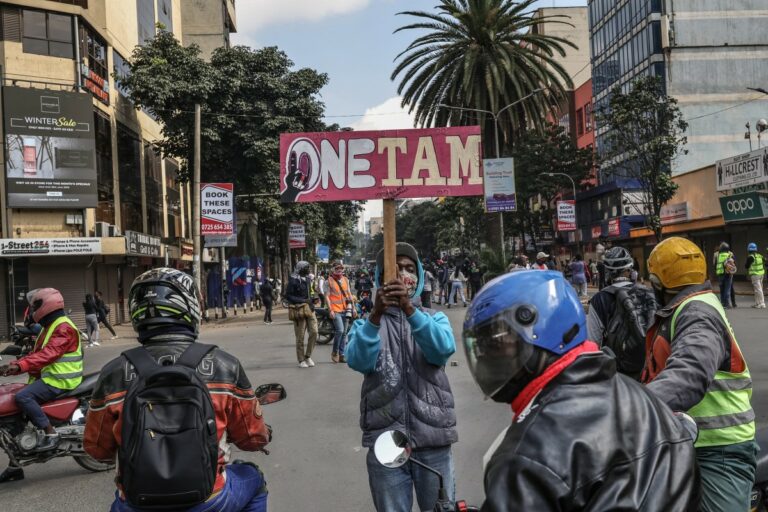
KENYA STREETS DESERTED AS POLICE BLOCK ROADS TO DETER ANTI-GOVERNMENT PROTESTERS ON SABA SABA DAY
Read Time:2 Minute, 34 Second
By Aishat Momoh. O.
Streets in Kenya’s capital Nairobi were largely deserted on Monday as police mounted roadblocks and deployed heavily across key routes to deter anti-government demonstrators marking the country’s annual Saba Saba Day.
The national holiday, observed on July 7 to commemorate the 1990 uprising against single-party rule, became a flashpoint once again as tensions simmer over economic hardship, state corruption, and police brutality.
Despite the heavy security presence, scattered protests erupted on the city’s outskirts. AFP reporters witnessed confrontations between small groups of protesters and anti-riot police, who fired teargas to disperse crowds. Protesters responded by hurling rocks and engaging in looting and vandalism. Two people were reportedly injured in the clashes.
Central Nairobi, usually bustling, resembled a ghost town as police erected at least 20 roadblocks, according to an interactive map widely circulated on social media and WhatsApp. Most businesses remained closed, and residents largely stayed indoors, fearing violence.
“I have never witnessed the city centre like this,” said Edmond Khayimba, a 29-year-old security guard.
Protesters on a major highway attempted to march into the city but were blocked by security forces. Chants of “Ruto Must Go” and “wantam” (short for “one term”) echoed through the air a reference to growing discontent with President William Ruto’s leadership.
“We will not relent and we will keep it going each and every day,” said Rogers Onsomu, a 32-year-old motorbike driver, citing healthcare and unfulfilled promises as drivers of youth unrest. “As the constitution says, the power belongs to the people.”
Since June last year, at least 80 people have died in protests, while rights groups report dozens of illegal detentions. Human rights organizations say the state has responded with increasing repression.
On Sunday, unidentified men armed with sticks stormed the Kenyan Human Rights Commission during a press conference that denounced enforced disappearances and extrajudicial killings. No injuries were reported, but the incident underscored rising tensions between the state and civil society.
Last month’s nationwide protests on June 25 left 19 people dead and hundreds arrested, according to human rights monitors. Demonstrators allege that the government is infiltrating protests with paid vandals to justify violent crackdowns a claim authorities deny.
President Ruto, elected in 2022, has since formed a fragile alliance with opposition leader Raila Odinga, leaving no strong challenger ahead of the 2027 general election. However, the government’s response to dissent is raising alarm.
“They are recycling tactics from the 1990s,” said Gabrielle Lynch, an African politics expert at the University of Warwick. “But we’re not in the nineties they don’t seem to have realised the world is different.”
Activist Nerima Wako warned that the cycle of repression and resistance is intensifying. “Every time people organise a protest, they kill more people, so it just continues to feed off itself,” she said.
As Saba Saba Day ends, Kenya remains on edge caught between growing youth-led agitation and an increasingly hardline state response.


Happy
0 %

Sad
0 %

Excited
0 %

Sleepy
0 %

Angry
0 %

Surprise
0 %
 0
0
 0
0