
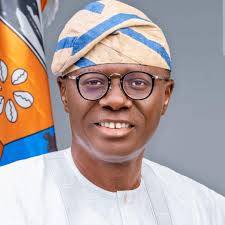
SANWO-OLU: SUBSIDY RESTORATION PROMISES ARE POPULIST POLITICS
Read Time:4 Minute, 13 Second
By:Tajudeen Aminat
Lagos State Governor, Babajide Sanwo-Olu, has criticised politicians campaigning on promises to restore Nigeria’s abolished fuel subsidy, describing such pledges as populist politics that would ultimately deceive Nigerians.
Sanwo-Olu spoke on Thursday while delivering the 7th Freedom Online Newspaper Lecture titled, “2027 Elections, Economy, Security and Nigeria’s Future,” held at the Sheraton Lagos Hotel in Ikeja.
The lecture was chaired by former Minister of Information and Culture, Alhaji Lai Mohammed, while former Ogun State Governor and Senator representing Ogun East, Gbenga Daniel, attended as the Special Guest of Honour.
Speaking on the country’s economic reforms, security situation and electoral system, Sanwo-Olu said the removal of the petrol subsidy was necessary because the policy had become a major drain on the nation’s finances.
He argued that funds previously spent on the subsidy could have been channelled into critical infrastructure, including roads, schools, hospitals and other public services.
According to the governor, President Bola Tinubu demonstrated political courage by removing the subsidy at the beginning of his administration, despite the potential impact of the decision on his political fortunes.
Sanwo-Olu acknowledged that the policy had imposed economic difficulties on Nigerians, particularly through higher transport and food costs, but maintained that the reform was beginning to produce positive results.
He said the removal of the subsidy had also resulted in a significant increase in monthly allocations to state and local governments.
The governor warned that opposition politicians were likely to make the restoration of fuel subsidy a major campaign promise ahead of the 2027 elections.
He said such promises could become unrealistic commitments that no government would be able to sustain.
Sanwo-Olu expressed support for the economic reforms introduced by the Tinubu administration, saying available economic indicators suggested that the measures were beginning to yield results.
He cited growth in the national economy, agriculture and services, as well as improvements in foreign reserves, trade balance, credit ratings and inflation.
According to him, Nigeria’s external reserves had risen to $53bn, while inflation had fallen from its peak of almost 35 per cent in late 2024 to 15.9 per cent in June 2026.
He also referenced Central Bank data showing that Nigerians in the diaspora remitted $947m through formal channels in July, describing the figure as the highest monthly inflow recorded in the country.
On democracy and elections, Sanwo-Olu said Nigeria’s political and electoral systems had continued to evolve since the return to democratic rule in 1999.
He said the country had made significant progress in its electoral process compared with previous election cycles, citing reforms introduced through the Electoral Act and the use of technology in voter verification and result transmission.
The governor, however, urged the Independent National Electoral Commission to ensure adequate preparations for the 2027 elections, stressing that all stakeholders had a responsibility to support the electoral body.
On security, Sanwo-Olu said the assessment of whether Nigeria was safer under the present administration depended partly on individual perceptions, but maintained that President Tinubu had given national security significant attention.
He linked poverty and unemployment to insecurity, noting that several Federal Government interventions were targeted at addressing the economic challenges confronting young Nigerians.
The governor highlighted measures including the expansion of the Nigerian Army, the establishment of new security commands, decentralisation of police training, and the deployment of Forest Guards and Mining Marshals.
He also cited youth-focused initiatives such as NELFUND, the Consumer Credit Corporation, the 3 Million Technical Talent programme, the reformed National Youth Service Corps, the Nigerian Youth Academy and other empowerment programmes.
Sanwo-Olu said these interventions were aimed at equipping young Nigerians with education, skills, employment opportunities and access to finance, which he described as essential to tackling the root causes of insecurity.
Earlier, Lai Mohammed described the Freedom Online lecture as an important intellectual platform for national reflection, saying Sanwo-Olu was well suited to address the complex issues of governance, security, infrastructure and economic development.
Mohammed argued that political stability was closely linked to economic inclusion, stressing that businesses could not thrive in an environment characterised by insecurity and uncertainty.
He urged political actors to approach the 2027 elections as an opportunity for nation-building rather than merely a contest for political power.
According to him, Nigeria’s democratic progress should be measured by the ability of elections to strengthen institutions, attract investment and promote peace.
The former minister acknowledged the Federal Government’s efforts to address the country’s economic and security challenges but stressed that the problems would require consistency, patience, institutional strengthening and national cooperation.
The Convener and Editor-in-Chief of Freedom Online, Gabriel Akinadewo, said the lecture was organised against the backdrop of increased political activities ahead of the 2027 elections.
Akinadewo urged political leaders to prioritise national development over political interests.
He also called for the modernisation of Nigeria’s laws to reflect contemporary realities, advocating the repeal of outdated legislation and the creation of a legal framework that would better protect citizens’ rights and freedoms.


Happy
0 %

Sad
0 %

Excited
0 %

Sleepy
0 %

Angry
0 %

Surprise
0 %
 0
0
 0
0