

FG COUNTERS ATIKU, OBI OVER IMF SPENDING CLAIMS
Read Time:3 Minute, 3 Second
By: Fasasi Hammad
The Federal Government has rejected claims that more than ₦8 trillion was spent outside the 2026 budget, describing the allegations as misleading and based on a misinterpretation of the International Monetary Fund’s (IMF) 2026 Article IV Consultation Report.
The government said reports suggesting that expenditure equivalent to about two per cent of Nigeria’s Gross Domestic Product (GDP) was incurred outside the approved budget framework were inaccurate and did not reflect the IMF’s actual findings.
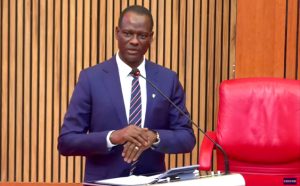
This position was contained in a statement issued on Sunday by the Minister of Finance and Coordinating Minister of the Economy, Taiwo Oyedele.
The clarification followed comments by the IMF indicating that public spending equivalent to roughly two per cent of GDP had not been fully reflected in official budget reports, creating discrepancies in fiscal reporting and understating the country’s financing requirements.
Speaking in Lagos, the IMF Resident Representative in Nigeria, Christian Ebeke, said the expenditure should be properly recorded and reported to eliminate statistical inconsistencies.
READ MORE….
The IMF remarks prompted criticism from opposition figures, including former Vice President Atiku Abubakar and NDC presidential candidate Peter Obi, who accused the administration of President Bola Tinubu of corruption and demanded further investigation.
However, Oyedele insisted that the Federal Government does not operate a parallel or “shadow” budget and that all public spending is carried out within the provisions of the Constitution and laws enacted by the National Assembly.
According to him, Sections 80 to 83 and 162 of the 1999 Constitution clearly stipulate that public funds can only be withdrawn and spent in accordance with constitutional and legislative approvals.
He explained that government expenditure is implemented through Appropriation Acts, Supplementary Appropriation Acts and other statutory instruments duly approved by lawmakers.
The minister further noted that multi-year capital projects spanning several budget cycles, as well as approved capital rollovers, are standard public finance practices and should not be interpreted as spending outside the budget.
He argued that claims of secret expenditure running into trillions of naira lack evidence, stressing that anyone making such allegations should identify specific projects allegedly executed without legislative approval.
Oyedele also pointed to statutory transfers, debt servicing obligations, first-line charges and intervention programmes established by law as legitimate components of Nigeria’s fiscal framework.
He listed allocations to development commissions, revenue collection costs retained by designated agencies, separately approved budgets for certain agencies and the Federal Capital Territory, infrastructure interventions, security-related expenditures, disaster response programmes and debt obligations among expenditures authorised by law.
According to him, these expenditures are legally backed, publicly disclosed and subject to oversight, auditing and accountability processes.
The minister also dismissed suggestions that the reported amount automatically translated into a larger fiscal deficit, explaining that deficits are determined by the relationship between government revenues and expenditures rather than the funding mechanism used for specific projects.
He maintained that the IMF’s observations were aimed at improving the comprehensiveness and presentation of fiscal reports rather than questioning the legality of government spending.
Oyedele added that President Tinubu had already proposed a more harmonised budgeting framework when presenting the 2026 Appropriation Bill to the National Assembly in December 2025, with the objective of eliminating overlapping budget structures.
He reaffirmed the administration’s commitment to transparency, accountability and prudent fiscal management, noting that ongoing reforms have strengthened budget implementation, revenue collection, treasury operations and the digitalisation of public finance processes.
The minister urged Nigerians to rely on accurate information when discussing fiscal matters, warning that misrepresenting technical observations as evidence of unlawful expenditure could distort public understanding and undermine informed debate.


Happy
0 %

Sad
0 %

Excited
0 %

Sleepy
0 %

Angry
0 %

Surprise
0 %
 0
0
 0
0