
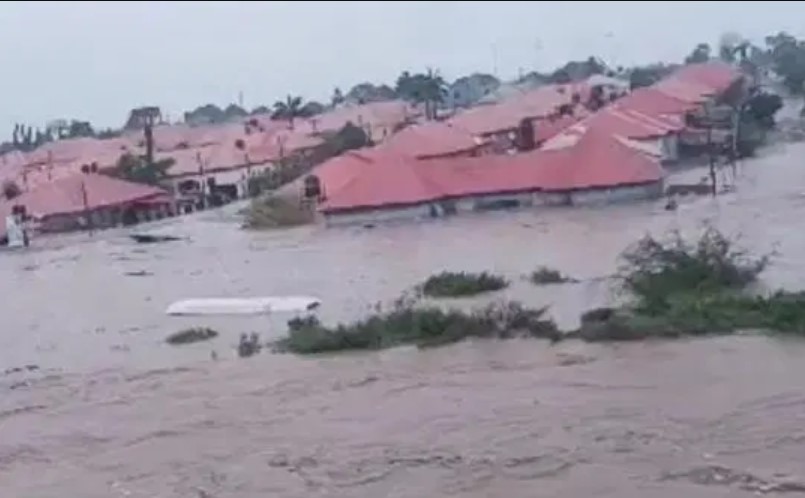
NIHSA WARNS OF PROLONGED FLOODING AS RAINS INTENSIFY
Read Time:2 Minute, 35 Second
By: Fasasi Hammad
The Director-General and Chief Executive Officer of the Nigeria Hydrological Services Agency (NiHSA), Umar Mohammed, has said that the recent flooding that ravaged Lagos and several other parts of the country was anticipated and should not have come as a surprise.
According to him, NiHSA had issued forecasts and early warnings ahead of the floods, but the alerts were largely ignored.
Speaking through the agency’s Head of Geographic Information Systems (GIS) and Remote Sensing, Emmanuel David Tuna, Mohammed explained that the agency relied on multiple forecasting models that accurately predicted the likelihood of severe flooding.
He warned that the current flooding could be only the beginning, noting that rainfall is expected to intensify between July and September, with the most severe impacts likely in August and September.
Mohammed also expressed concern over the potential contamination of drinking water sources in affected communities, stressing that prolonged flooding could compromise water quality and pose public health risks.
READ MORE…
Last week, torrential rainfall lasting more than 12 hours submerged roads, homes and businesses across Lagos, disrupting commercial activities and leaving many residents stranded. The downpour affected major routes and communities, including the Lagos-Oshodi Expressway, Abeokuta Expressway, Lekki-Epe Expressway, Victoria Island, Agege, Ikeja, Oworonsoki, Gbagada, Funsho Williams Avenue, Yaba and several coastal areas.
The NiHSA boss attributed Lagos’ vulnerability to its unique geography, describing the state as a coastal city exposed to urban, riverine and tidal flooding. He noted that the combination of these flood types can significantly worsen the impact whenever they occur simultaneously.
He further explained that some parts of Lagos lie at or below sea level, making drainage difficult and increasing the risk of prolonged flooding. According to him, field assessments revealed blocked and silted drainage channels, many already filled with stagnant water even before the peak of the rainy season.
Mohammed said the situation has been aggravated by the overflow of tributaries linked to the Ogun River, which are feeding into already flooded urban areas and increasing the volume and intensity of floodwaters.
He cautioned that if urgent remedial measures are not taken, flooding could persist for days or even weeks, especially as the ground has become saturated and unable to absorb additional rainfall efficiently.
The NiHSA chief maintained that the agency had repeatedly warned about the likelihood of severe flooding and had also raised concerns about the impact on water quality. He disclosed that the agency had begun monitoring water sources before the floods and plans to conduct post-flood assessments to determine the extent of contamination.
While predicting that flooding will gradually ease from October, Mohammed said residents should expect intermittent flooding throughout the July-to-September period. He added that conditions may only fully stabilise around November.
He also lamented what he described as poor cooperation from some state governments, saying flood warnings are often disregarded until disaster strikes.
“Many times, we issue alerts before flooding begins, but because there is no immediate danger, the warnings are not taken seriously,” he said.


Happy
0 %

Sad
0 %

Excited
0 %

Sleepy
0 %

Angry
0 %

Surprise
0 %
 0
0
 0
0