
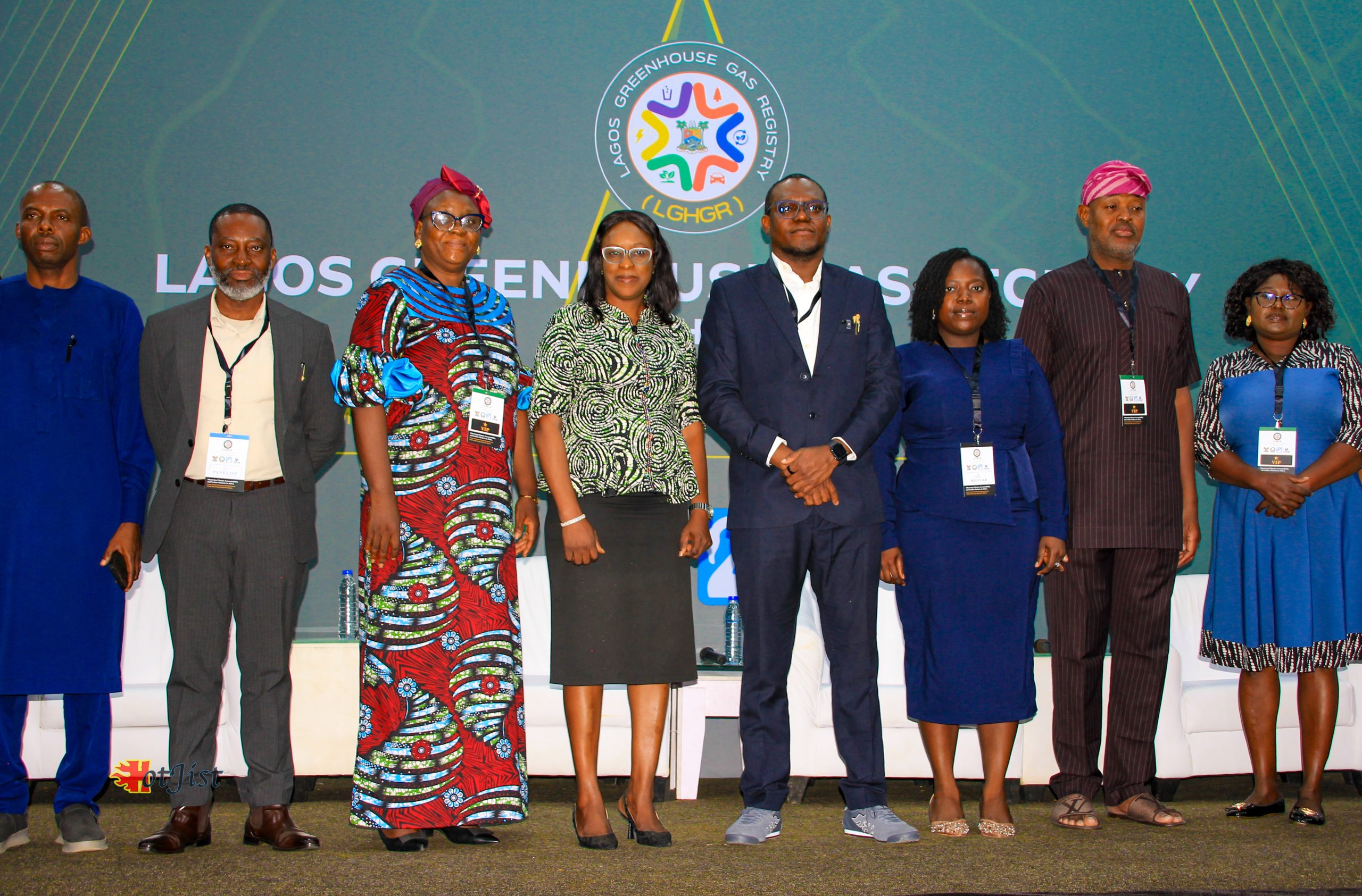
LASEPA, PARTNERS LAUNCH LAGOS GREENHOUSE GAS REGISTRY TO STRENGTHEN EMISSIONS TRACKING, CLIMATE ACTION
Read Time:3 Minute, 55 Second
By ‘Sefiu Ajape

The Lagos State Government, through the Lagos State Environmental Protection Agency (LASEPA), on Monday officially launched the Lagos Greenhouse Gas Registry (LGHGR), a digital platform designed to strengthen greenhouse gas emissions tracking, improve climate governance and support evidence-based environmental decision-making.
The online Measurement, Reporting and Verification (MRV) platform, launched at NECA House, Alausa, in partnership with Swanlux Global Investments Limited and TPHG Technologies Limited, is expected to systematically measure, monitor, report and manage greenhouse gas emissions and air pollutants across the state.
Speaking at the launch, the General Manager of LASEPA, Dr. Tunde Ajayi, disclosed that the registry was redesigned after an earlier version introduced about two years ago recorded low compliance from industries and organisations.
According to him, the agency returned to the drawing board and adopted a new public-private partnership model to improve participation and ensure the platform delivers on its objectives.
“The first one we launched was done by the government, but the business space doesn’t quite respect regulatory organisations that get involved. So, we have to bring in the private sector,” Ajayi said.
He noted that Lagos, being the manufacturing and commercial hub of West Africa, generates significant carbon emissions that must be properly documented to support climate action, attract funding and improve public health outcomes.
Ajayi explained that the registry would help establish a clear relationship between greenhouse gas emissions, environmental pollution and the health of residents, stressing that proper documentation is essential for accessing climate finance.
“You cannot get funding for what you don’t properly document,” he said.
He added that investing in environmental protection yields significant public health benefits, noting that for every one dollar spent on environmental protection, about 40 dollars are saved in health costs.
According to him, increased investment in environmental protection, including cleaner energy and clean cooking initiatives, would reduce pollution-related illnesses while improving the overall well-being of residents.
Ajayi also disclosed that several organisations had already registered on the platform, adding that plans were underway to establish what he described as Nigeria’s and Africa’s first sub-national carbon training platform.
Also speaking, the Lagos State Commissioner for Health, Prof. Akin Abayomi, described climate change as one of the greatest public health challenges facing governments worldwide, noting that Lagos, as a low-lying coastal megacity, remains particularly vulnerable to its impacts.
He said the registry would help stimulate a green economy by enabling climate financing to flow from carbon-emitting activities into projects that absorb emissions, including tree planting, renewable energy and environmentally sustainable infrastructure.
“The endpoint of climate aberration is lack of health or loss of well-being,” Abayomi said.
He added that documenting emissions would support mitigation efforts while creating incentives for businesses and individuals to adopt environmentally friendly practices.
Representing the Minister of Environment, Hon. Balarabe Abbas Lawal, the Federal Controller of Environment, Southwest, Mrs. Adenaike Olabimpe, commended Lagos State for pioneering the initiative, describing the registry as an evidence-based platform that would strengthen Nigeria’s climate response.
She said reliable emissions data would improve climate planning, mitigation, adaptation and access to climate financing, expressing confidence that other states would learn from Lagos’ example.
Speaking on behalf of Swanlux Global Investments Limited, Mrs. Victoria Awe, representing the company’s Managing Director, Mr. Isaac Ajana, said the partnership reflected the private sector’s commitment to promoting accountability, transparency and measurable environmental impact through digital climate solutions.
She noted that the growing impacts of climate change—including flooding, rising temperatures, food insecurity and public health concerns—underscore the need for innovative, data-driven approaches to environmental management.
Also speaking, the Lead Consultant of TPHG Technologies Limited, Dr. Mofoluso Fagbeja, described the registry as the beginning of a new climate economy for Lagos and Nigeria.
In a separate interview with Hotjist, Fagbeja said the platform would provide more comprehensive data on greenhouse gas emissions, particularly from the industrial sector, helping government agencies better understand the relationship between emissions, air quality and public health.
He said previous assessments estimated that air pollution contributes to about 30,000 premature deaths, with 51 per cent occurring among children under the age of five, underscoring the importance of accurate emissions monitoring and data-driven policy interventions.
The event featured the official unveiling of the Lagos Greenhouse Gas Registry website by the LASEPA General Manager, a live demonstration of the platform’s operations and a panel discussion on advancing transparent emissions management through digital MRV systems.
The Lagos Greenhouse Gas Registry is expected to support Nigeria’s climate commitments under the Paris Agreement, strengthen emissions reporting, improve environmental governance and position Lagos as a leading sub-national government driving climate resilience and sustainable development in Africa.


Happy
0 %

Sad
0 %

Excited
100 %

Sleepy
0 %

Angry
0 %

Surprise
0 %
 2
2
 0
0